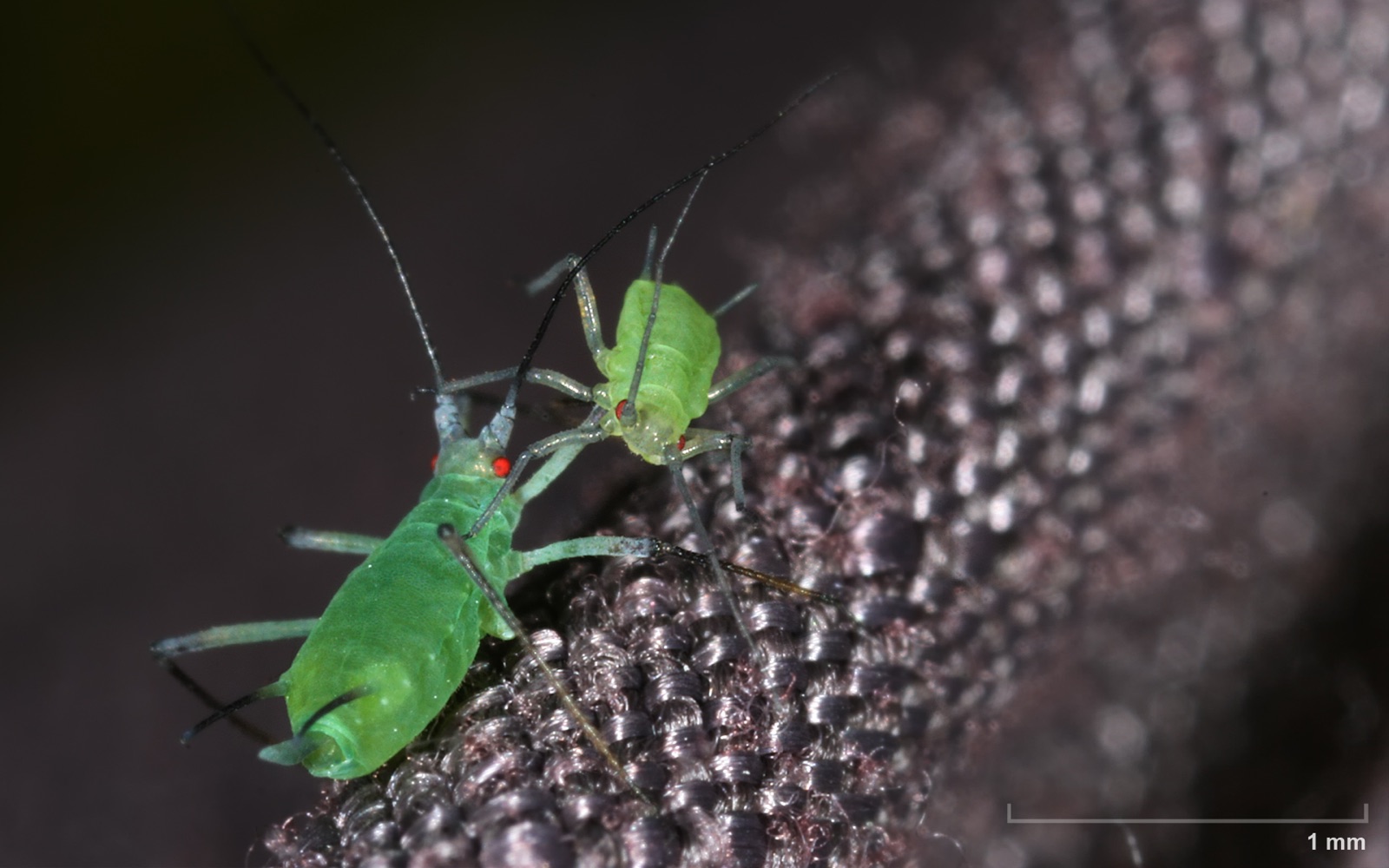
What they are
A superfamily, Aphidoidea. Roughly 5,000 described species. Soft bodies, two cornicles on the rear, a beak like a hypodermic needle.
They feed on phloem, the sugar pipeline running down a stem. A single aphid pulls more sap than it can use, then excretes the surplus as honeydew. That sticky drip is the trail of bread crumbs that ants, wasps, and sooty mold all follow back to the colony.
Most of the year, every aphid you see is female and pregnant. The next generation is already developing inside her, and the generation after that is developing inside those embryos. Russian dolls of clones.
Why they multiply so fast
No mating, no waiting. A green peach aphid born today can be a grandmother in eight days. Under summer conditions a single founder will produce 50 to 100 offspring, each capable of the same trick.
When the colony gets crowded, or the host plant starts to fail, the next generation hatches with wings. Those alates lift off, ride the wind for kilometers, and land on a fresh plant to start over. This is how a clean garden gets colonized in a single afternoon.
Sexual reproduction kicks in once a year on most species, late autumn, to lay overwintering eggs. Everything else is parthenogenetic. Clones of clones of clones.
The real damage
The feeding itself rarely kills a healthy plant. Curled leaves, stunted shoots, sticky residue, yes. But a vigorous tomato or rose absorbs the loss.
The viruses are the problem. Aphids vector hundreds of plant pathogens. Cucumber mosaic, potato leafroll, plum pox, barley yellow dwarf, beet western yellows. The aphid picks up the virus in seconds at the first plant and injects it into the next one within minutes. By the time you notice the colony, the infection has already moved.
Two downstream symptoms tell you aphids were here even after they leave. Honeydew on the leaves below the colony. Black sooty mold growing on that honeydew, blocking light from the leaf surface. Both are aphid signatures.
The ants are not your friends
Several ant species farm aphids the way humans farm dairy cows. They stroke the aphid with their antennae to trigger a honeydew droplet, carry the droplet back to the nest, and in return they defend the herd from predators.
A trail of ants running up a stem in spring almost always means aphids above. The ants will fight off ladybird larvae and parasitoid wasps. Break the farming relationship and the predators move in within days.
A sticky band around the trunk, the same trick used against leafcutter ants, works here too. Tanglefoot at 30 cm off the ground, replaced after rain. Cuts the ant supply line and lets natural enemies do their job.
Who eats them
This is where the leverage is. Aphids are the base of an entire predator economy, and most working gardens have those predators already.
Ladybird larvae. The adults get the credit, the larvae do the work. One alligator-shaped larva eats 200 to 400 aphids before pupating. Learn to recognize them. They look nothing like the red beetle and people squash them by mistake.
Lacewing larvae. Called aphid lions for good reason. Pale, jaw-forward, voracious. A single larva clears 200 to 300 aphids in two to three weeks.
Hoverfly larvae. Small green or brown maggots that crawl through colonies eating one aphid every few minutes. The adult hoverflies need flowers to lay near the next generation. Plant umbellifers.
Parasitoid wasps. Aphidius and related genera lay one egg inside an aphid. The larva eats the host from the inside, leaving a bronze, papery mummy stuck to the leaf. Count the mummies. That is your biocontrol working.
When to actually intervene
Most aphid outbreaks resolve themselves in two to three weeks once predators arrive. Watch first, spray never as the default. Observation-first is the whole game.
Intervene only when: a young transplant is being overwhelmed before it can outgrow the damage, a virus-susceptible crop is in early flower, or the colony is on a plant where you cannot tolerate sticky honeydew dripping below.
A strong jet of water from the hose dislodges 70 to 90 percent of a colony. Most knocked-off aphids never make it back. Repeat every three days for a week. This costs nothing and harms nothing else.
Insecticidal soap, 1 to 2 percent dilution, sprayed at dusk on the underside of leaves. Works by suffocation, kills on contact, has no residual effect. Will also kill ladybird larvae and lacewings if you hit them. Spot-spray the colony. Never blanket the plant.
Neem oil at label rate is slower but disrupts the molt cycle. Same rule. Spot only.
The thing you do not do is broad-spectrum synthetic insecticide. One spray and you wipe out the predator population that was about to solve the problem for free. The aphids bounce back in two weeks with nothing to stop them.
When it goes wrong
The colony rebounds after spraying. You killed the predators along with the aphids. Stop spraying. Plant a strip of yarrow, fennel, dill, or alyssum to bring beneficials back. Expect six to eight weeks of recovery.
Curled leaves with no aphids visible. They were there. Unfurl a curled leaf and look at the inside surface, or check whether ants are still patrolling the stem. The damage persists after the colony moves.
Sooty mold takes over. Wipe affected leaves with a damp cloth and address the aphids above. The mold itself does not infect the plant. It blocks light.
Same plants attacked every year. That plant is either stressed, over-fertilized with nitrogen, or genetically susceptible. Soft, nitrogen-rich growth is aphid candy. Cut back the feeding, switch to compost, or replace with a resistant variety.