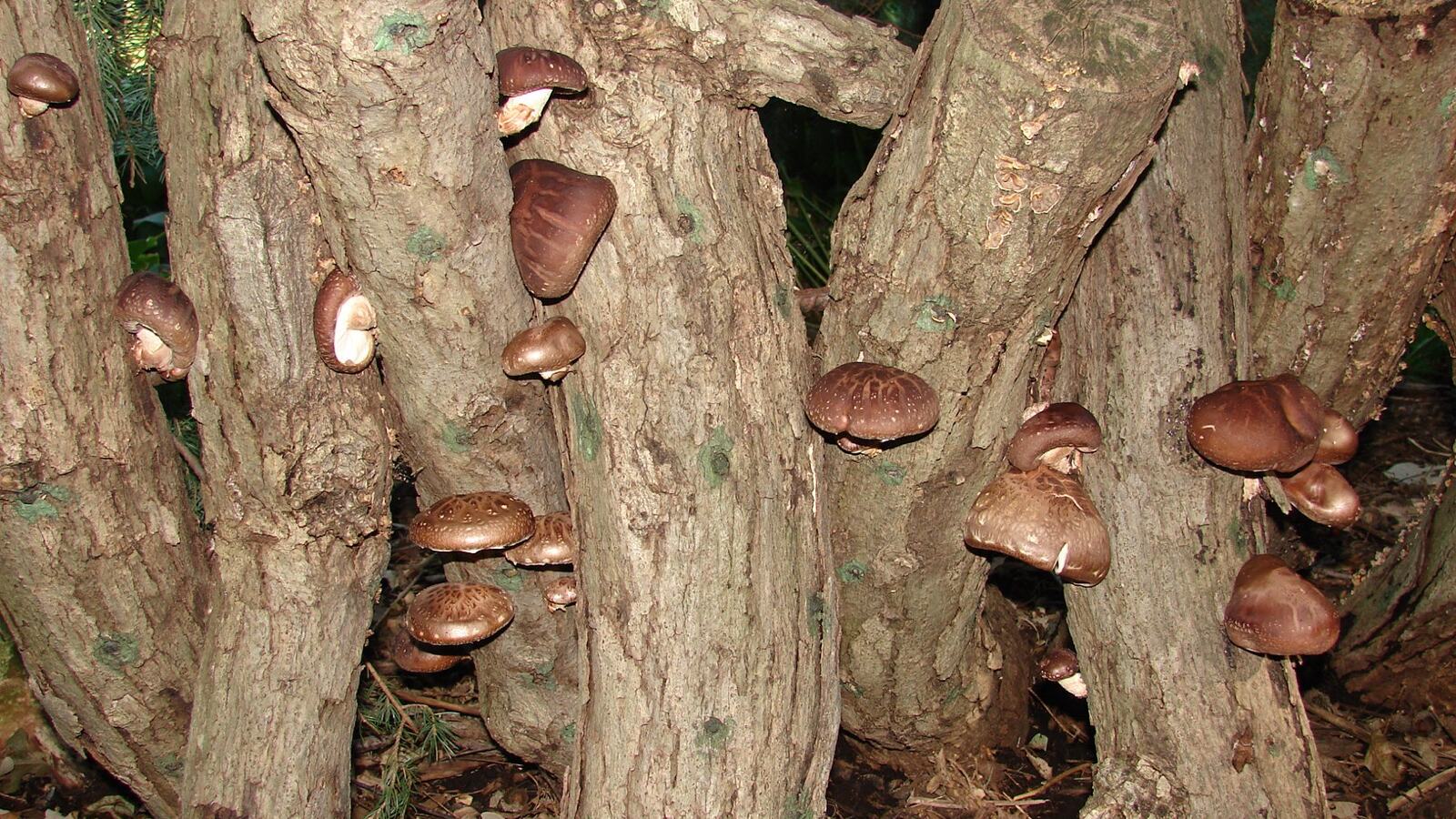
A different kind of fungus
Most fungal coverage in growing concerns mycorrhizal fungi, which partner with living roots, or pathogens, which attack living tissue.
Cultivated mushrooms are mostly neither. They are saprophytes: decomposers that break down dead organic matter, and the same organisms doing the work described in decomposers and the soil food web.
The mushroom is only the fruiting body. The organism is the mycelium, a network of fine threads running through the substrate, often for years before it fruits at all.
Which is why cultivation is really substrate management. Give the mycelium the material it wants, keep competitors out, then trigger fruiting.
Why grow them
Yield from waste. Mushrooms grow on material that has no other use: logs too small for timber, coppice thinnings, straw, sawdust, spent coffee grounds, cardboard. It is a crop from a waste stream rather than from land.
Shade tolerance. They fruit in conditions where nothing else productive grows, which makes them the true understorey layer of a food forest. A shaded north-facing corner is a liability for vegetables and ideal for logs.
Protein and nutrition from a system needing no fertiliser and little water.
They finish the cycle. Spent substrate is excellent compost, and mushroom cultivation converts woody material into soil far faster than composting alone. See composting methods.
Log cultivation
The lowest-input method and the best match for anyone managing woodland.
Cut the right logs. Freshly felled hardwood, 10 to 20 cm diameter, cut into 1 m lengths. Cut in the dormant season when sugar reserves are highest.
Species matters. Oak, beech, and hornbeam are the classic shiitake woods and give long production. Birch, alder, and poplar are softer, colonise faster, and are exhausted sooner. Avoid conifers for most edible species, and avoid anything with antifungal heartwood.
Wait, but not long. Use logs 2 to 6 weeks after felling. Fresh-cut wood still has natural antifungal defences, and older wood has already been colonised by wild fungi that will outcompete your inoculum.
Inoculate. Drill a diamond pattern of holes roughly 20 to 30 mm deep, spaced 15 to 20 cm along the log and 5 to 8 cm between rows. Hammer in colonised dowel plugs, or pack in sawdust spawn. Seal each hole with wax to keep moisture in and contaminants out.
Incubate. Stack the logs in deep shade, off the ground, and keep them damp. The mycelium spreads through the log over 6 to 18 months depending on species and wood density. Patience is the main requirement.
Fruit them. Most species fruit naturally after rain once colonised. Shiitake can be forced by soaking logs in cold water for 12 to 24 hours, which shocks the mycelium into fruiting, and a well-managed log will produce every couple of months in the warm season for 4 to 6 years.
This dovetails exactly with coppice rotation. Coppicing produces exactly the diameter of hardwood that log cultivation wants, on a cycle, as a byproduct of woodland management that is happening anyway. See woodland management.
The species worth starting with
Oyster, Pleurotus ostreatus and relatives. The most forgiving and the fastest. Grows on almost anything cellulose-based: straw, sawdust, coffee grounds, cardboard, logs. Colonises aggressively enough to outcompete most contaminants, which makes it the right beginner species. Fruits within weeks on straw.
Shiitake, Lentinula edodes. The classic log mushroom. Slower to establish, then productive for years. Higher value, well suited to woodland systems.
Wine cap, Stropharia rugosoannulata. Grown in wood chip beds outdoors, and probably the easiest of all in a garden context. Spread spawn in a chip mulch path or bed, keep it damp, and it fruits while simultaneously breaking the chips down into compost. It does double duty as a mulch system. See soil cover.
Lion's mane, Hericium erinaceus. Logs or supplemented sawdust, high value, distinctive.
Button and portobello, Agaricus bisporus. The supermarket mushroom, grown on composted manure rather than wood, and the most demanding to do well because the compost preparation is exacting.
Straw and indoor methods
Faster and higher-yielding than logs, and correspondingly more exposed to contamination.
The principle is to give your fungus a head start: pasteurise the substrate to knock back competing moulds and bacteria without sterilising it completely, then inoculate heavily so your species colonises before anything else establishes.
Straw is pasteurised by hot water soaking at around 65 to 80 C for an hour or two, or by a cold lime bath, which is simpler at small scale. It is then drained, mixed with spawn, and packed into bags or columns.
Colonisation happens warm and dark. Fruiting is triggered by exposing the block to light, fresh air, and high humidity, and the difference between a good flush and a poor one is almost always air exchange and humidity rather than anything else.
Spent coffee grounds deserve a mention: already pasteurised by brewing, abundant, free, and nitrogen-rich. Oyster mushrooms grow readily on them, and the combination is one of the neatest small-scale waste-to-food loops available.
Contamination and safety
Green mould, Trichoderma, is the usual enemy: it outcompetes edible species and it is the reason for pasteurisation, clean handling, and heavy inoculation rates.
Poor air exchange causes long stems and small caps. Insufficient humidity causes aborted pins.
On safety, two rules matter absolutely. Never eat a wild mushroom without confident identification from a reliable source, since several deadly species resemble edible ones closely. And when cultivating, know exactly what you inoculated and label it, because a contaminated block should be discarded rather than eaten.
Some people react to spores from heavy indoor fruiting, so ventilate and harvest before caps flatten and release spores in quantity.
Beyond food
The same organisms have uses that go well beyond eating.
Mycoremediation uses fungi to break down contaminants, including hydrocarbons and some persistent pollutants, and oyster mushrooms are the workhorse. See bioremediation.
Mycelium materials are grown into packaging, insulation, and construction panels by letting mycelium bind agricultural waste and then heat-treating it.
Soil building. Fungal decomposition of woody material is what converts lignin into stable soil organic matter, and it is a central mechanism in organic matter building and hugelkultur.
Inoculating a hugelkultur mound or a wood chip path with wine cap does all of this at once: it produces food, accelerates decomposition, and builds soil.
See also
- Decomposers the ecological role
- Coppice Rotation the source of the logs
- Mycorrhizal Fungi the other kind of fungus
- Hugelkultur inoculating buried wood
- Bioremediation fungi cleaning contamination
- Food Forest Design the true understorey crop
- Wood Decay Fungi