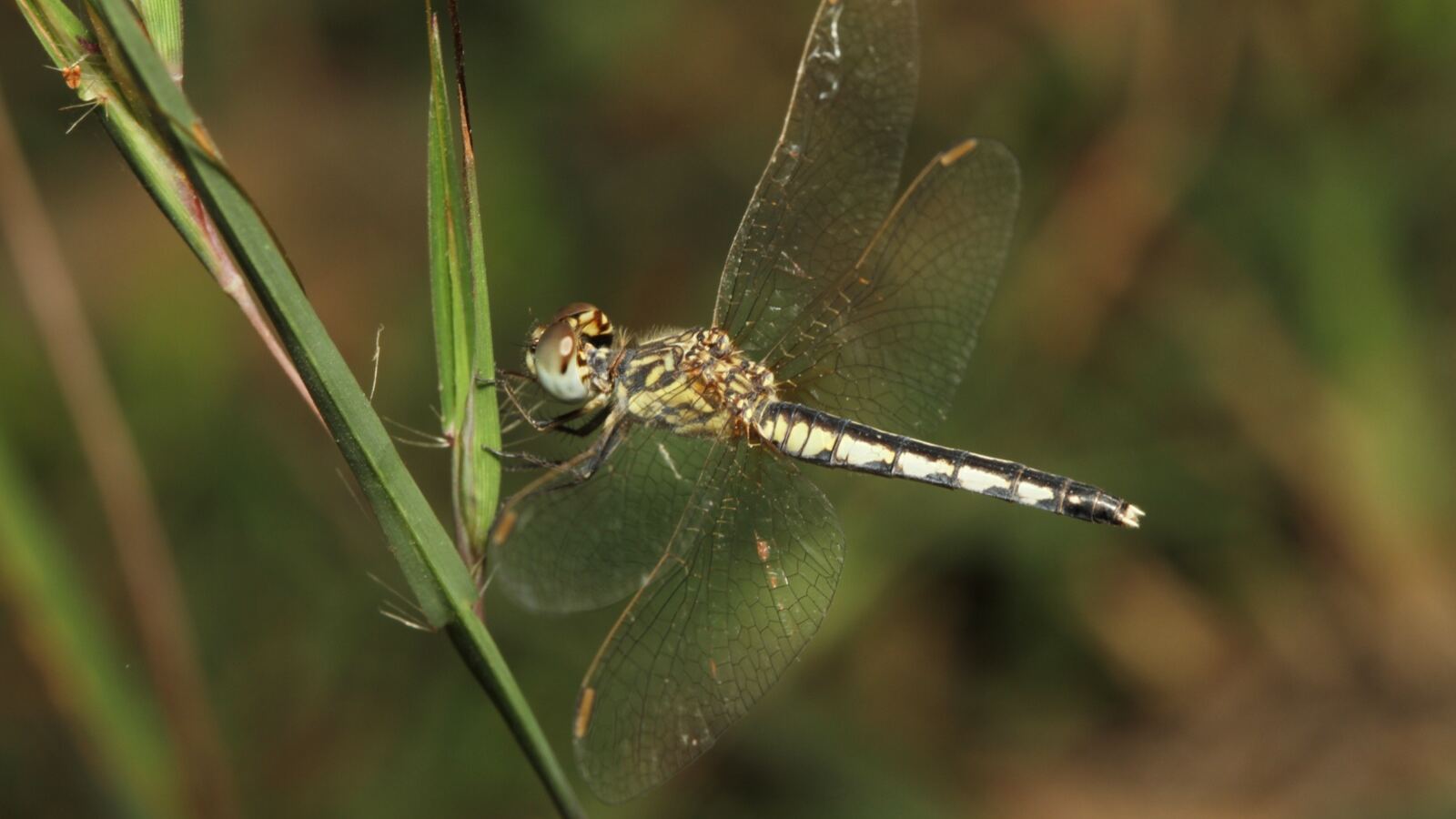
The adult is the short part
A dragonfly spends most of its life underwater.
Depending on species and climate, the larva — properly a nymph — lives submerged for one to five years, moulting a dozen times or more, hunting continuously. The winged adult lives a few weeks.
So when you look at a pond, the dragonflies are already there, invisible, and have been for years. That reframes what pond management means: draining, dredging, or letting a pond dry destroys a multi-year population that will take as long to rebuild.
An extraordinary predator, twice
The nymph is an apex invertebrate predator of still water, taking insect larvae, tadpoles, worms, and small fish.
Its hunting apparatus is unique: a hinged, extendable lower jaw — the mask — folded beneath the head and shot forward hydraulically to seize prey, faster than the eye follows. Nothing else in the insect world has it.
The adult is equally formidable. Dragonflies have among the highest recorded prey capture rates of any predator, commonly cited at over 90 percent of attempted intercepts. They achieve it with independently controlled wings allowing hovering, backward and sideways flight, near-360-degree vision from enormous compound eyes, and — remarkably — predictive interception, calculating where prey will be rather than chasing where it is.
They take mosquitoes, midges, flies, and other flying insects in quantity, which is the practical case for encouraging them.
Dragonflies and damselflies
Both are Odonata, and telling them apart is easy:
Dragonflies are robust, hold their wings open and flat at rest, have eyes that meet or nearly meet on top of the head, and are strong direct fliers.
Damselflies are slender, fold their wings along the body at rest, have widely separated eyes, and flutter weakly.
Damselfly nymphs have three leaf-like tails, dragonfly nymphs do not.
Emergence
The transition is worth watching for, and it happens at a predictable place.
The mature nymph climbs a stem clear of the water, grips it, and the adult splits out of the larval skin, expands its wings by pumping haemolymph into them, hardens, and flies.
The empty larval case — the exuvia — stays gripped to the stem, and it is the best evidence a pond is actually breeding dragonflies rather than merely being visited by them. Surveys count exuviae for exactly this reason.
Emergence requires emergent vegetation: stems that project above the water surface for the nymph to climb. A pond with steep bare margins and no emergent plants may hold nymphs that cannot complete their life cycle.
The rest of the pond
A functioning pond is a whole community, and dragonflies sit near the top of it.
Water beetles, including the great diving beetle, whose larvae are ferocious predators. Water boatmen and backswimmers, one feeding on algae, one predatory. Pond skaters, hunting the surface film. Caddisfly larvae, building portable cases of sand and plant fragments — and among the most useful water quality indicators available, since most species need clean well-oxygenated water. See indicator species. Mayfly and stonefly nymphs, likewise sensitive to pollution. Freshwater snails and shrimp, grazing and shredding. Amphibians, whose tadpoles are both grazers and prey.
The presence or absence of the sensitive groups tells you more about water quality than most chemical tests. See water quality testing.
Building a pond they will use
The requirements are specific and mostly free.
No fish. Fish eat nymphs, tadpoles, and eggs comprehensively. A stocked ornamental pond supports a fraction of the invertebrate life of an unstocked one. This is the single most consequential decision.
Sun. Dragonflies are strongly heliothermic and most species need warm open water. A pond in full shade supports far fewer.
Shallow, gently shelving margins, which is where most of the life is, and which also lets animals get out.
Emergent vegetation for emergence, plus submerged oxygenators and some floating cover.
Varied depth, including a section deep enough not to freeze solid or dry out.
A rough, unmown surround. Adults hunt and roost in vegetation near water, and the terrestrial margin is part of the habitat, not decoration.
Rainwater rather than tap water, which is high in nutrients and encourages algae. See rainwater harvesting basics.
Several small ponds beat one large one, since they vary in depth, temperature, and drying, and support different assemblages.
See self-sufficient ponds and rain gardens, both of which double as habitat.
Do not stock it
Ponds colonise themselves, and quickly — dragonflies and water beetles fly in, and most other groups arrive on birds, on the wind, or on visiting amphibians. A new pond typically has a substantial invertebrate community within a single season.
Introducing plants or animals from another pond risks moving invasive aquatic plants, which are among the most damaging invasive species in freshwater, and amphibian diseases including chytrid fungus and ranavirus. See invasive species.
Let it fill and let it arrive.
At larger scale
Dragonflies are useful indicators in wetland restoration because they integrate conditions over years and respond to habitat structure rather than single variables.
They also need connectivity — most species disperse, and isolated ponds support fewer species than networks of ponds within flight range of each other. See wetland restoration and wildlife corridors.
Beaver-created wetland is exceptionally good dragonfly habitat for exactly the reasons above: shallow, sunny, structurally varied, vegetated, and fish-poor in the smaller pools. See beavers.
See also
- Amphibians and Reptiles the other pond vertebrates
- Self-Sufficient Ponds building water that manages itself
- Indicator Species caddis and mayfly as water quality signals
- Beavers the animal that builds this habitat at landscape scale
- Wetland Restoration the same principles scaled up
- Beneficial Predators dragonflies in the wider guild