What it is
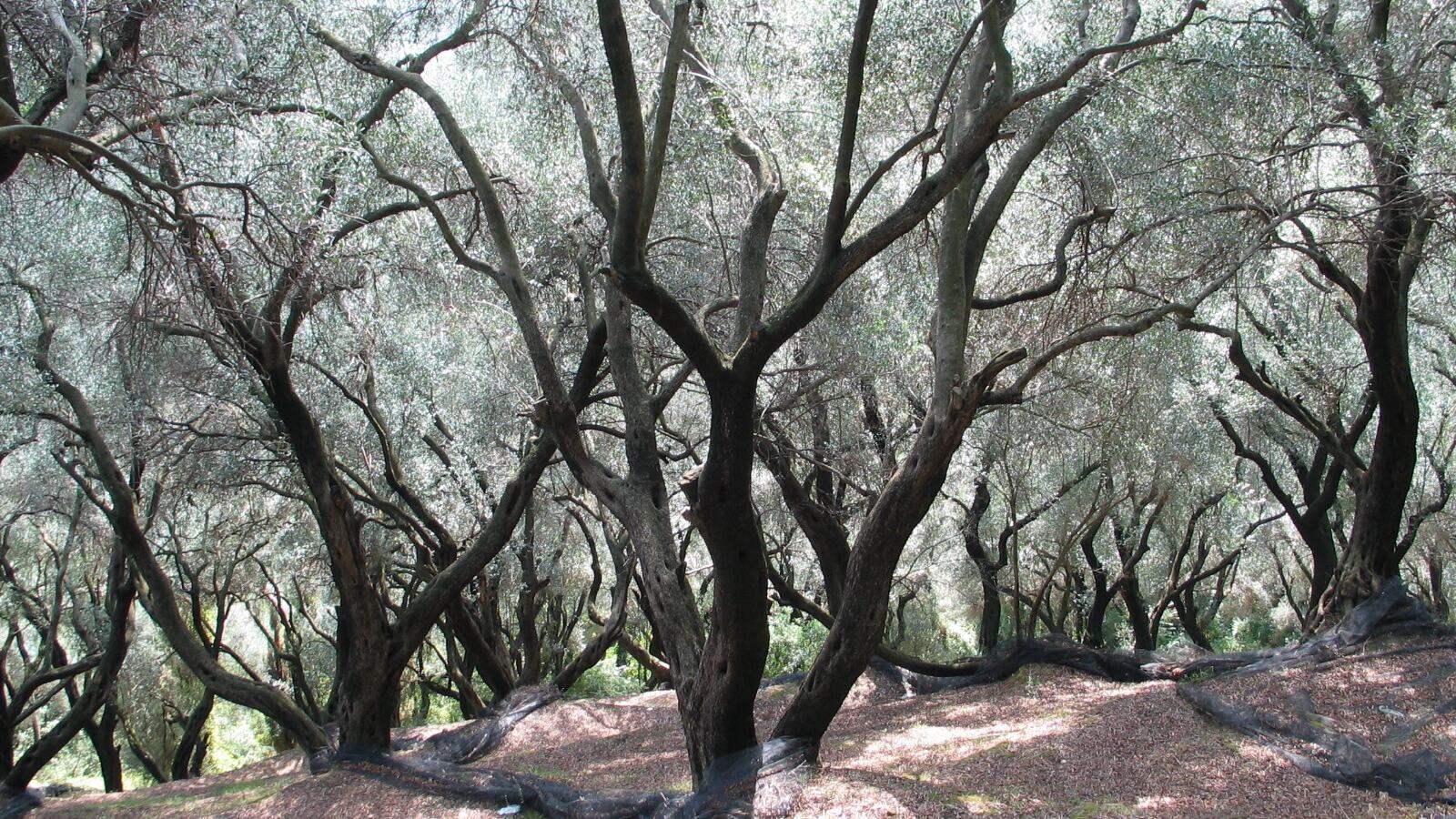
Olea europaea, in the same family as ash and lilac. Evergreen, small to medium, with narrow leaves that are dark above and silver-scaled beneath, which is what gives an olive grove its characteristic shimmer.
Domesticated in the eastern Mediterranean somewhere around 6,000 years ago, and inseparable from the history of the region since. Olive oil was food, fuel, medicine, cosmetic, and currency.
Effectively immortal
Olives do not really die of old age. The trunk hollows and the heartwood rots away, but the tree continues, regenerating from basal suckers and from surviving strips of living tissue running up the outside.
An ancient olive is often not a single trunk but a ring of connected fragments around a hollow, all one organism. Trees of 1,000 years are common in the Mediterranean, and several are credibly estimated at 2,000 years or more.
Cut an olive to the ground and it regrows from the burl at the base. Burn it and it regrows. This regenerative capacity is why olive cultivation survived war, neglect, and abandonment for millennia, and why groves abandoned for a century can be brought back into production.
It also means propagation is straightforward: cuttings, truncheons, and the woody basal burls all root readily. See propagation.
Built for drought
Olive is a reference species for dry-climate growing, and the adaptations are worth understanding because the same principles apply elsewhere.
Small, thick, leathery leaves with a waxy cuticle minimise water loss. The silver undersides are dense scales that trap humidity and reflect light. Stomata are sunk in pits and close during the hottest part of the day. Roots are extensive and go deep, and mature trees survive on rainfall alone in places receiving 300 to 500 mm a year.
Under severe drought an olive can shed leaves, halt growth entirely, and simply wait, resuming when rain returns. Survival first, production second.
The tree does need winter chill to flower, roughly 200 to 300 hours below about 10 C, which is why olives fail to fruit reliably in the tropics and in mild maritime climates. They will grow as ornamentals far outside their fruiting range.
Frost is the limit at the other end: damage below about minus 8 to minus 10 C, death below roughly minus 12.
See drought-tolerant species and Mediterranean shrubs for the wider dry-climate palette.
Alternate bearing
Olives characteristically crop heavily one year and lightly the next.
A heavy crop consumes the tree's reserves and suppresses the formation of the flower buds that would produce next year's crop, which are initiated during the current season. So a big year forces a small year, which allows a big year, and the oscillation is self-sustaining.
Thinning fruit in heavy years, pruning to stimulate new growth, and consistent nutrition all moderate it without eliminating it. Commercial groves manage it; traditional groves largely live with it.
The same phenomenon affects apples and pears, where it is called biennial bearing, and the fix, thinning early, is the same.
Why you cannot eat them off the tree
Raw olives are inedible: intensely bitter from oleuropein, a phenolic compound.
Processing removes it. Traditional methods use repeated water changes over weeks, brine fermentation over months where lactic acid bacteria break the compound down, dry salt curing, or lye treatment for the fast commercial process. Fermented brine curing produces the most complex flavour and takes the longest.
Oil is different: the bitterness compounds largely stay with the water fraction during pressing, and the phenolics that do carry into the oil are what give good olive oil its peppery finish and much of its antioxidant value.
Oil extraction is mechanical. Fruit is crushed to a paste, the paste is malaxed to let droplets coalesce, and the oil is separated by centrifuge or press. Extra virgin means first extraction, mechanical only, below a defined acidity, and free of defects. Quality depends heavily on how quickly fruit is processed after picking, since fruit left in heaps ferments and the oil is ruined.
Xylella
Xylella fastidiosa, a bacterium spread by sap-sucking insects, has killed millions of olive trees in Puglia, southern Italy, since 2013, including groves containing trees over a thousand years old.
The bacterium blocks the xylem, and the tree dies of drought while standing in wet soil. There is no cure. Management is containment: removing infected trees, controlling the insect vectors, and restricting plant movement.
It has an extraordinarily wide host range across many hundreds of plant species, and it has now been found in Spain, France, and Portugal. It is one of the most serious plant health threats in Europe, and it arrived, like so many others, through the ornamental plant trade.
Resistant cultivars exist and replanting with them is underway, but a two-thousand-year-old tree cannot be replaced. See tree diseases and nursery stock on biosecurity.
Groves as habitat
Traditional olive groves, widely spaced ancient trees with grazed or cultivated ground beneath, are high-biodiversity systems. Hollow trunks provide nest sites for owls, rollers, and bats, and the understorey carries rich Mediterranean flora.
They are effectively a form of silvopasture, and they have been managed that way for millennia.
Intensive and super-intensive olive production is a different proposition: hedgerow plantings at very high density, irrigated, mechanically harvested, and replaced on a 15 to 20 year cycle. Yields per hectare are far higher, biodiversity is close to zero, and the water demand is significant in regions that cannot spare it. The expansion of irrigated olive in parts of Spain has contributed directly to aquifer depletion. See wells and boreholes and salinity.
The choice between these two models is the live question in Mediterranean agriculture, and the abandonment of traditional groves that are no longer economic is causing losses in both biodiversity and cultural landscape.
Growing them
Full sun, sharp drainage, and poor soil are all fine. Olives fail in heavy wet ground more often than in drought.
Prune to an open vase shape for light penetration and airflow, since fruit forms on the previous year's wood and the interior of a congested tree produces nothing. Prune in late winter to early spring, before flowering.
Most cultivars are partly self-fertile and all crop far better with a pollinator variety nearby, since olive is wind-pollinated.
In cool climates, grow in a container that can be moved under shelter for winter, and accept that fruiting will be unreliable. See container growing.
See also
- Mediterranean Shrubs the companion planting palette
- Drought-Tolerant Species the wider dry-climate list
- Tree Diseases Xylella in context
- Silvopasture traditional groves as grazed systems
- Apples and Pears the same alternate bearing problem
- Propagation rooting olive cuttings