What a lichen is
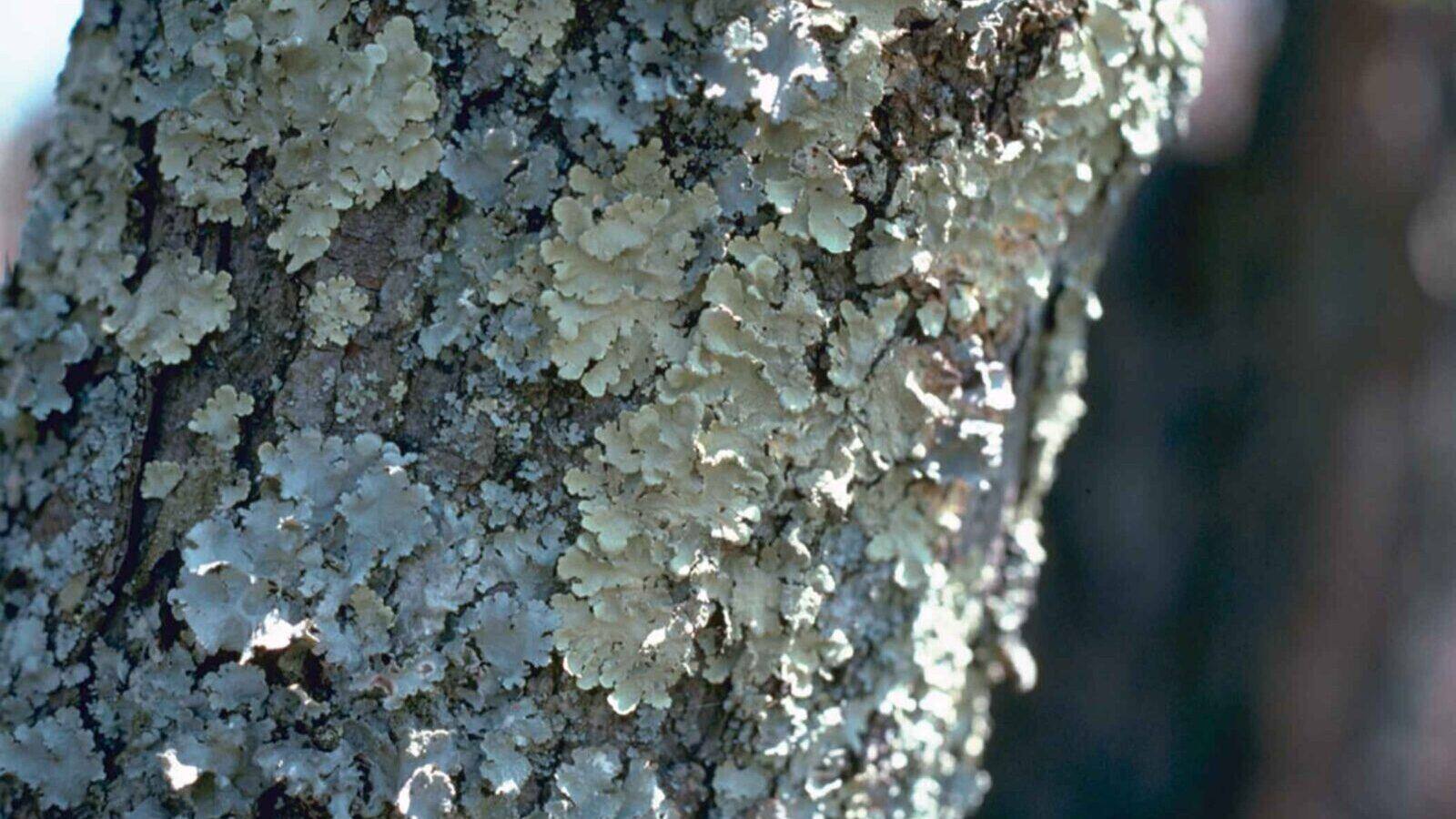
Not one organism. A lichen is a fungus farming photosynthetic partners, either algae or cyanobacteria, held in a structure the fungus builds.
The fungus provides shelter, moisture retention, and mineral capture. The photosynthetic partner provides sugars. Recent work has shown that many lichens also involve a third partner, a specific yeast in the outer layer, which explains variation that could not previously be accounted for.
The composite survives conditions neither partner could tolerate alone, which is why lichens grow on bare rock, on gravestones, in deserts, and in the Antarctic. They are among the first colonisers of new surfaces and among the slowest-growing organisms on earth, some crustose species expanding less than a millimetre a year and individual thalli estimated at thousands of years old.
Three growth forms are worth recognising: crustose, forming a crust bonded to the surface; foliose, leafy and lobed with a distinct upper and lower surface; and fruticose, shrubby or hair-like and attached at one point.
Air quality meters
Lichens have no roots and no waxy cuticle. They absorb water and everything dissolved in it directly across their whole surface, and they cannot excrete pollutants.
That makes them exceptionally sensitive to air quality, and it makes them one of the oldest and most reliable biological monitoring tools available.
Sulphur dioxide is the classic sensitivity. In the industrial era, urban areas became lichen deserts, with only the most tolerant crustose species surviving on walls. Following clean air legislation and the decline of coal, sensitive fruticose species have recolonised many British and European cities, and mapping that return is one of the clearest ecological records of pollution control working.
Nitrogen is now the dominant issue. Ammonia from intensive agriculture and nitrogen oxides from traffic favour a distinct group of nitrogen-tolerant species, mostly bright yellow-orange Xanthoria and Physcia, while sensitive species disappear.
So the community composition reads the air. Abundant bushy grey-green Usnea and Evernia indicate clean air. A tree covered only in bright orange crusts indicates high nitrogen. Bare bark in an otherwise suitable location indicates a pollution problem.
Standardised survey methods exist and are used by regulators, which makes this a genuinely practical indicator species application.
Woodland continuity
A second, different diagnostic use. Some lichens disperse poorly and grow slowly, and they occur only where suitable bark has existed continuously for centuries.
Their presence indicates ancient woodland or long-established wood pasture, and the standard tools for assessing this are indices based on assemblages of such species. A high score means the site has had continuous canopy cover for a very long time, which cannot be recreated by planting.
The same logic applies to certain bryophytes, particularly in the wet oceanic woodlands of western Britain and Ireland, which support internationally important bryophyte and lichen communities found almost nowhere else.
This matters directly for restoration decisions, since it distinguishes irreplaceable habitat from recreatable habitat. See historical ecology and woodland management.
Old trees carry the richest assemblages: stable bark, varied texture, long time available for colonisation. A single ancient tree may support more lichen species than an entire young plantation, which is one of the strongest arguments for retaining veteran trees. See dead wood habitat.
They are not killing your tree
The persistent misconception, and worth addressing plainly.
Lichens and mosses growing on bark are epiphytes. They use the tree as a perch. They have no roots penetrating the bark, take nothing from the tree, and do not cause disease.
The correlation people notice is real but reversed. Heavy lichen and moss growth is common on trees that are already declining, because a thinning canopy admits more light to the branches and a slow-growing tree has stable bark that is not shedding. The lichens are a symptom of an open canopy, not a cause of decline.
Scrubbing lichens off, or spraying them, damages bark, removes habitat, and treats nothing. If a tree is declining, look for the actual cause: root damage, compaction, waterlogging, a buried root flare, or disease. See tree planting, tree diseases, and nutrient deficiency.
Moss on a lawn is different, and it is a genuine indicator: it points to compaction, shade, poor drainage, low fertility, or acidity. Treat the cause rather than the moss. See soil ph and decompaction.
Mosses and water
Bryophytes — mosses, liverworts, hornworts — have no vascular tissue and no true roots. They absorb water across their whole surface and many can dry out completely and rehydrate without damage, a trait called poikilohydry.
They hold remarkable quantities of water. Sphagnum can hold something like 15 to 20 times its dry weight, and that capacity is what builds and maintains peat bogs. Sphagnum both stores water and acidifies its surroundings, creating the anoxic acidic conditions that prevent decomposition and allow peat to accumulate.
That makes moss the engine of the largest terrestrial carbon store on the planet. See peatland restoration.
In woodland, moss layers intercept rainfall, slow runoff, hold humidity at ground level, and provide germination sites for tree seedlings. On thin soils and rock they are the pioneers that begin soil formation, trapping dust and organic matter until vascular plants can establish. See pioneer species and soil water storage.
Encouraging them
If you want them, the requirements are simple and mostly about restraint.
Clean air, which you may not control.
Time and stability. Old trees, undisturbed surfaces, continuity. Nothing substitutes.
Humidity. Shade, shelter, and proximity to water. Wet western woodlands are lichen and bryophyte strongholds for this reason.
Varied surfaces. Different bark textures and pH, plus stone, deadwood, and bare ground. Rough-barked oak and smooth-barked beech carry different communities, and nutrient-rich bark such as ash and elder supports another set again.
No cleaning, no spraying, no tidying. Pressure-washing walls, scrubbing trunks, and removing deadwood all remove decades of growth in minutes.
Lichens also matter as habitat and material: they are the food of many invertebrates, and birds use them extensively as nest camouflage, with long-tailed tits binding lichen into their nests with spider silk. Reindeer depend on ground lichens. Historically they supplied dyes for Harris tweed and litmus.
See also
- Indicator Species reading condition from what grows
- Historical Ecology continuity indicators
- Peatland Restoration sphagnum as the engine
- Dead Wood Habitat veteran trees as substrate
- Tree Diseases diagnosing actual decline
- Woodland Management retaining old trees