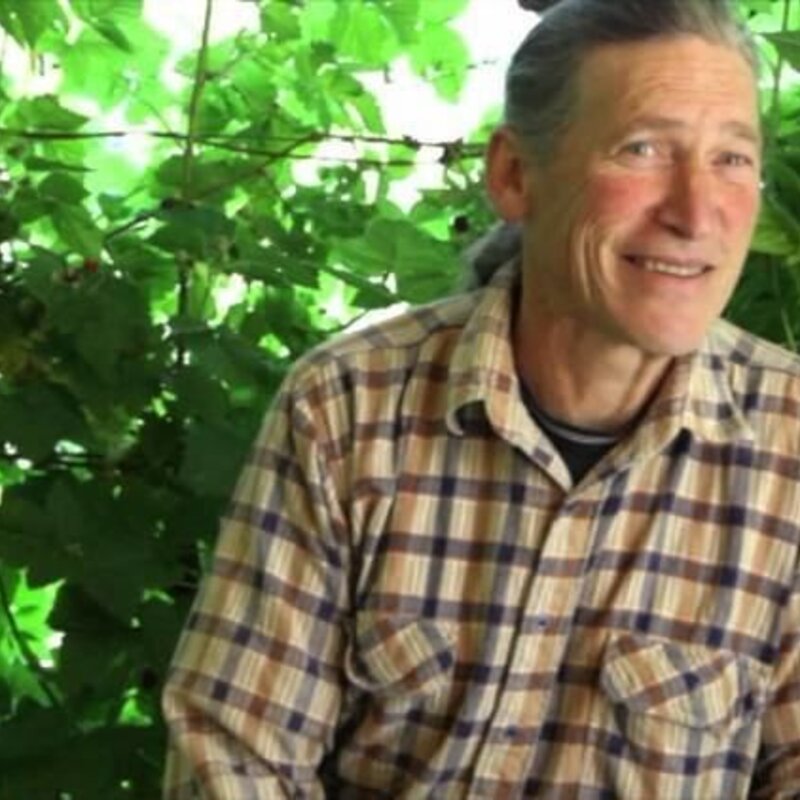
The Student
David Holmgren was born in 1955 in Fremantle, Western Australia, to politically active parents. He grew up in a household where questioning industrial society was ordinary dinner conversation.
In the mid-1970s he was studying environmental design at the College of Advanced Education in Hobart, Tasmania. There he met Bill Mollison, a lecturer twenty-seven years his senior with an encyclopedic field knowledge of Tasmanian ecology and a growing conviction that agriculture had to be redesigned.
The collaboration that followed was genuinely joint, and the division of labour is worth recording accurately. Mollison supplied the ecological observation, the field experience, and much of the energy. Holmgren did most of the writing.
Permaculture One was published in 1978 under both names. Holmgren was 23 and had written the manuscript as a student project.
Stepping Back
Where Mollison went out to teach the world, Holmgren did close to the opposite.
He spent the following decades in relative quiet, refining the ideas, testing them on the ground, and writing carefully. He was uncomfortable with the movement's tendency toward evangelism and with claims that ran ahead of evidence.
In 1985 he and his partner Su Dennett began developing Melliodora, a one-hectare property at Hepburn Springs in central Victoria. It became one of the most thoroughly documented permaculture demonstration sites anywhere: a cold-temperate hillside developed into an intensively productive system of orchards, dams, terraces, animals, and an energy-efficient house.
The significance of Melliodora is that it has been measured. Holmgren has published detailed accounts of its yields, costs, water, and energy over decades, including its failures. That empirical honesty distinguished his work from a movement often criticised for asserting results without recording them.
The Twelve Principles
In 2002 Holmgren published Permaculture: Principles and Pathways Beyond Sustainability, and it reframed the field.
Mollison's Designers' Manual was an encyclopedia of techniques. Holmgren's book set out something more portable: twelve design principles, each a short prompt applicable in any climate, culture, or context.
Observe and interact. Catch and store energy. Obtain a yield. Apply self-regulation and accept feedback. Use and value renewable resources. Produce no waste. Design from patterns to details. Integrate rather than segregate. Use small and slow solutions. Use and value diversity. Use edges and value the marginal. Creatively use and respond to change.
The principles are deliberately abstract. None specifies a technique, which is precisely why they transfer between a Sahelian smallholding and a suburban garden.
They are set out in working form in permaculture design, and they underpin a great deal of what appears throughout this encyclopedia. Observation first is the first principle stated on its own. Chop and drop and composting are produce no waste. Structural diversity and polyculture are use and value diversity. Edge effects is the eleventh principle with the ecology attached.
Holmgren also broadened the definition. Permaculture, in his formulation, stopped being permanent agriculture and became permanent culture: a design system for land, buildings, economies, and social arrangements alike.
Energy Descent
Holmgren's later work is more uncomfortable than the gardening material, and he considers it the more important part.
His argument, developed in Future Scenarios and elsewhere, is that industrial civilisation is built on a temporary surplus of cheap fossil energy, and that the descent from that surplus is not optional. The question is only whether it is designed or chaotic.
He mapped four scenarios for how that descent might play out, from a technologically managed transition to abrupt collapse, and argued that permaculture is best understood as the practical toolkit for the middle ground.
This led to his advocacy of retrofitting the suburbs, an argument that the existing suburban landscape, with its land, water catchment, and building stock, is the most realistic site for transition in wealthy countries. Not new eco-villages on cheap rural land, but the streets people already live in.
That position has been influential well beyond permaculture, particularly on the Transition Towns movement.
The Contrast
The two founders make an instructive pair.
Mollison was a bushman, a raconteur, and an evangelist who gave the system away and let it propagate. Holmgren is a writer and a systems thinker who stayed on one hillside for forty years, kept records, and published the numbers.
Permaculture needed both. Without Mollison it would probably not have spread. Without Holmgren it might not have survived intellectual scrutiny, and it would certainly lack the principles that made it teachable outside Mollison's own voice.
Holmgren continues to live and work at Melliodora, and remains a working critic of the movement he helped start, particularly of the tendency to treat its techniques as a checklist rather than a design method.
See also
- Bill Mollison the co-originator
- Permaculture Design the zones, sectors and principles
- Observation First the first principle
- Food Forest Design the flagship application
- Sepp Holzer a parallel practitioner in cold mountains