The canopy of the tropical homegarden
Tropical homegardens are among the oldest and most productive agroforestry systems on earth, and these are the trees that form their upper layers.
They are not grown in rows. In a Kerala or Javanese homegarden, mango, jackfruit, coconut, and banana occupy different heights above a understorey of spices, vegetables, and medicinal plants, and the whole thing functions as a food forest that has existed for centuries.
Understanding each species' layer and habit is what lets you assemble that rather than a collection of competing trees.
Mango
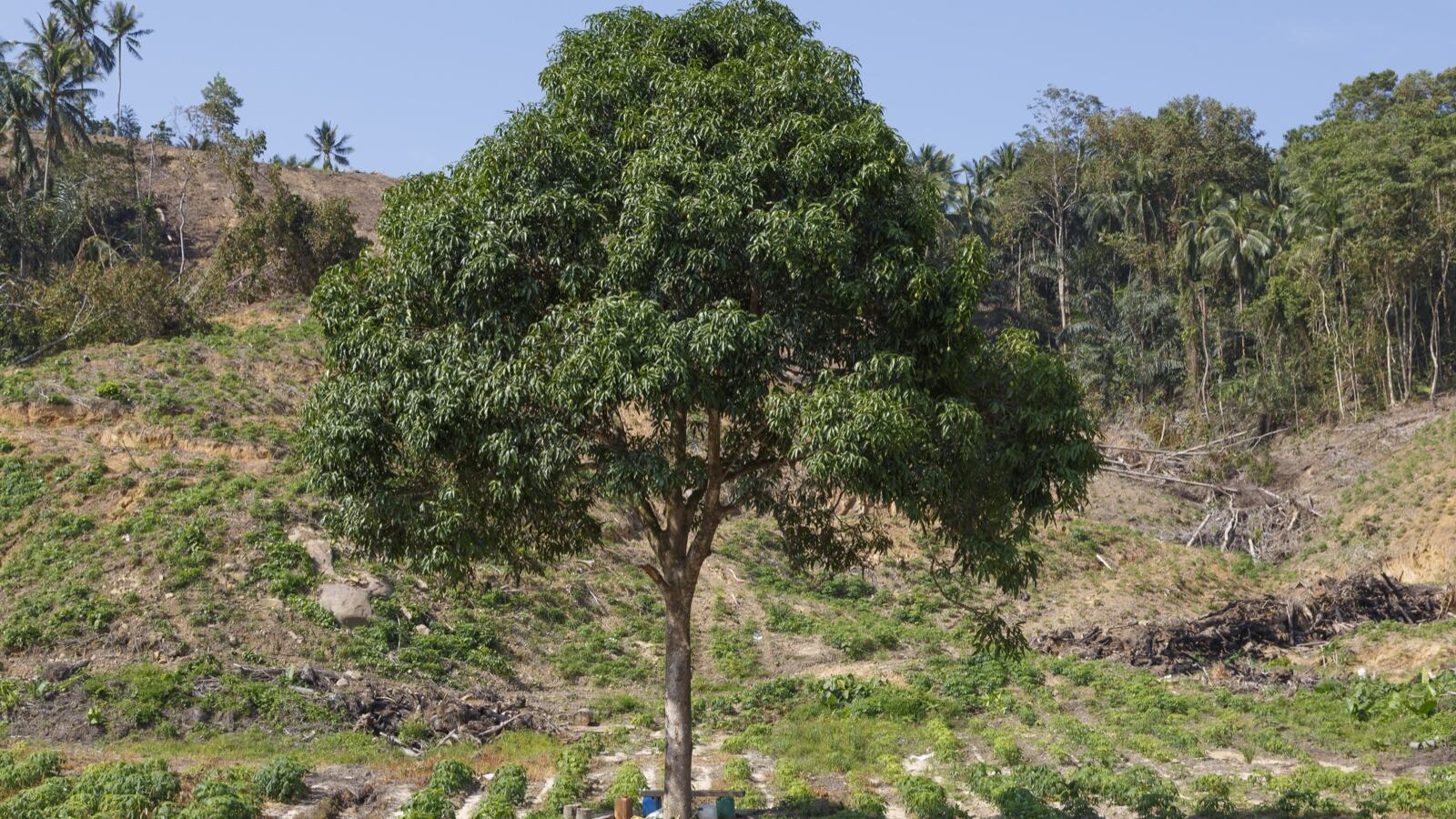
Mangifera indica. Large, long-lived, evergreen, and the most widely grown tropical fruit in the world. Trees reach 30 m and live well over a century, though grafted orchard trees are kept far smaller.
Flowering needs a trigger. Mango sets flower in response to a cool dry period or, in equatorial regions with no cool season, to water stress. This is why mango cropping is unreliable in constantly wet equatorial climates and excellent in monsoon climates with a defined dry season. Rain during flowering causes anthracnose and destroys the crop, which makes the dry season timing critical.
Grafted, always, for fruit. Seedling mangoes take 8 or more years and vary. Grafted trees fruit in 3 to 5 and come true. Note that many mango varieties are polyembryonic, producing several seedlings from one seed, most of which are clones of the mother, which is a natural cloning route unusual among fruit trees. See grafting.
Alternate bearing is pronounced, as in olive and apple.
Mango is drought-tolerant once established, deep-rooted, and productive on poor soil, which makes it a robust choice in dryland tropics.
Avocado
Persea americana, in the laurel family. Three races, Mexican, Guatemalan, and West Indian, differing in cold tolerance and oil content, with most commercial varieties being hybrids. Hass is a Guatemalan-Mexican hybrid, and every Hass tree on earth is a clone of one seedling grown in California in the 1920s.
The flowering is genuinely strange. Avocado flowers are functionally both male and female but at different times of day, a system called synchronous dichogamy. Type A varieties open female in the morning and male the following afternoon. Type B varieties do the reverse.
The purpose is avoiding self-pollination. The practical consequence is that yields improve substantially when an A and a B variety are planted together, and that cool weather disrupts the timing and wrecks fruit set.
Roots are the weak point. Avocado is exceptionally sensitive to Phytophthora cinnamomi root rot and to waterlogging. It demands free drainage above almost everything else, and planting on a mound is standard practice. Resistant rootstocks are the main defence. See tree diseases.
Water use is high, and avocado's expansion into dry regions such as Michoacán and parts of Chile has caused serious water conflict and deforestation. It is one of the clearest current examples of a fruit crop driving hydrological and land-use damage. See wells and boreholes.
Avocado also has an evolutionary curiosity: its large seed appears adapted for dispersal by megafauna that went extinct thousands of years ago, leaving it dependent on humans.
Jackfruit
Artocarpus heterophyllus. The largest fruit borne on any tree, routinely 10 to 25 kg and occasionally over 40. Borne directly on the trunk and main branches, which is cauliflory, an adaptation for supporting enormous weight.
Jackfruit is arguably the most underrated tree crop in the world.
A single mature tree can produce 100 to 200 fruits a year, which is a very large amount of food from one plant. It is drought-tolerant once established, thrives on poor soil, resists pests, needs almost no management, and lives for decades.
The fruit is used two ways: ripe, sweet, and eaten fresh; and unripe, where the fibrous flesh is cooked as a starchy vegetable and has become widely known as a meat substitute. The seeds are edible when boiled or roasted and are nutritionally comparable to other pulses.
The obstacles are practical rather than agronomic: fruit is enormous and awkward to handle, the latex is sticky and difficult, and processing is labour-intensive. Enormous quantities rot unused in India and Bangladesh for want of processing and market.
The timber is also excellent, durable, and traditionally used for furniture and for the robes of Buddhist monks, coloured with dye from its heartwood.
Papaya
Carica papaya. Not really a tree but a giant herbaceous plant with a single unbranched stem, which changes everything about how it is grown.
It is fast. Fruit within 6 to 12 months of sowing, which is faster than any tree crop. It is correspondingly short-lived, declining after 3 to 4 years, and is best treated as a semi-perennial to be replaced on a cycle rather than a permanent planting.
Sex matters. Plants may be male, female, or hermaphrodite. Males produce no fruit. Traditional practice is to plant several seedlings per station and remove the males once flowering reveals them, keeping one hermaphrodite or female with a male nearby.
Frost and wind are fatal. The shallow root system and heavy top make it prone to blowing over, and it has no cold tolerance at all.
Papaya's speed makes it the classic gap-filler in a young food forest, producing food in the first year while the slower canopy species establish. That role, fast yield while the system matures, is exactly what syntropic agriculture formalises with its placenta and secondary species.
Papain, the enzyme in the latex, is used as a meat tenderiser and digestive aid, and the leaves have well-documented traditional medicinal use.
Assembling them
The species differ in height, lifespan, and light demand, which is what allows stacking rather than competition:
Emergent and canopy: mango, jackfruit, and mature avocado. Sub-canopy: citrus, guava, smaller avocados. Fast gap-fillers: papaya and banana. Understorey: cacao and coffee, spices, and shade-tolerant crops.
Plant the fast, short-lived species alongside the slow, long-lived ones from the start. The papaya and banana feed you for the first three years, then give way as the mango and jackfruit close the canopy above them.
That succession is the core design principle. See food forest design, succession planting, and structural diversity.
Also plant for the birds and bats that pollinate and disperse many tropical species, since fruit set frequently depends on them. See bats and fig species.
See also
- Food Forest Design how the layers assemble
- Banana and Plantain the other fast gap-filler
- Cacao and Coffee the understorey cash crops
- Fig Species tropical keystone fruit
- Syntropic Agriculture stacking species in time
- Grafting and Rootstocks why seedling mangoes disappoint