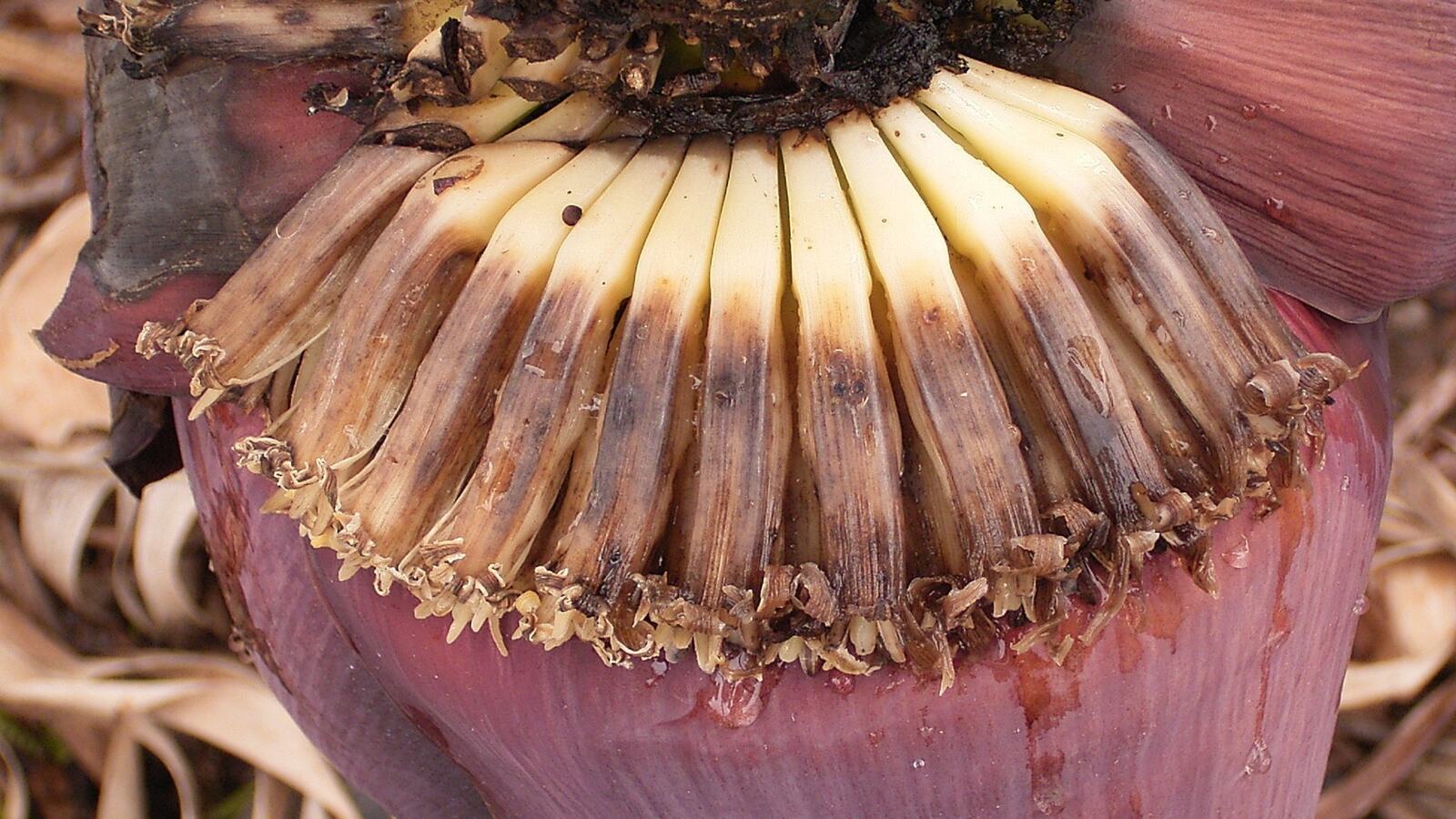
Not a tree
Musa, a giant herbaceous perennial. What looks like a trunk is a pseudostem made of tightly wrapped leaf bases, and it contains no wood at all.
The real stem is underground: a corm from which leaves, roots, and suckers emerge. The plant grows to full height in under a year, produces one bunch of fruit, and then that pseudostem dies. The corm sends up replacements.
So a banana "plant" is really a continuous colony. You harvest a stem, cut it down, and the next sucker is already growing.
Bananas are the fourth most important food crop in the world by production, and in parts of East Africa cooking bananas provide a substantial share of daily calories.
Bananas and plantains
The distinction is culinary rather than botanical. Both are Musa, and the split is between dessert types eaten raw when ripe and cooking types with higher starch, lower sugar, and firmer flesh that are boiled, fried, or roasted.
Most cultivated bananas derive from two wild species, Musa acuminata and M. balbisiana, and varieties are described by their genome combination — AA, AAA, AAB, ABB — which predicts much of their behaviour and use.
Wild bananas are full of hard black seeds and barely edible. Domesticated ones are seedless, parthenocarpic, producing fruit without fertilisation.
No seed means clones
Because cultivated bananas are sterile, every plant is propagated vegetatively from suckers or tissue culture. Every Cavendish banana on earth is genetically identical.
This has a straightforward consequence: the crop has no genetic variation to draw on when a disease arrives, and a pathogen that can kill one plant can kill all of them.
That is not hypothetical. It has already happened once and is happening again.
Panama disease, a soil-borne Fusarium wilt, destroyed the Gros Michel variety that dominated the global export trade until the 1950s. The industry survived by switching wholesale to Cavendish, which was resistant to that strain.
Tropical Race 4 is a newer strain of the same fungus, and Cavendish has no resistance. It persists in soil for decades, cannot be controlled chemically, and has spread from Asia to Australia, the Middle East, Africa, and now Latin America. There is no replacement variety ready.
Alongside it, black sigatoka leaf disease requires intensive fungicide programmes in export plantations, with real costs to workers and water.
The lesson is the one that runs through tree diseases and structural diversity: a genetically uniform crop grown as a vast monoculture is an unhedged bet. Smallholder systems growing many local varieties in mixed gardens are far more robust, and they hold most of the genetic diversity that a solution will have to come from. See seed banking.
Managing suckers
The core skill in growing bananas, and it is simple once understood.
A mat, the clump of corm and suckers, will produce more shoots than it can support. Left alone it becomes a congested thicket of thin stems and small bunches.
Standard practice keeps three at a time in sequence: one mature stem fruiting, one well-grown follower, and one young sucker. Everything else is removed. The result is a continuous harvest, one bunch after another, indefinitely.
Prefer sword suckers, which have narrow lance-shaped juvenile leaves and a strong corm connection, over water suckers, which have broad leaves, a weak connection, and produce poor bunches.
After harvest, cut the spent pseudostem down and leave it on the ground. It is roughly 90 percent water and full of potassium, and it decomposes rapidly into exactly the nutrients the mat needs. Chopping and dropping the stems and leaves is the whole fertility system in a well-run banana circle. See chop and drop.
Biomass and the banana circle
Bananas are heavy feeders and heavy drinkers, and they produce a great deal of biomass, which makes them a useful component rather than merely a crop.
The banana circle is a widely used permaculture technique: a shallow pit a couple of metres across, ringed by a mound planted with bananas and papayas. Kitchen greywater and organic waste go into the pit, the bananas feed on it, and the pit's mulch holds moisture. It turns a waste stream into food and needs no external inputs. See greywater systems and permaculture design.
In layered systems bananas occupy the fast, medium-height, short-lived niche: quick shade, quick biomass, and a yield within a year while slower canopy trees establish. That is precisely the role assigned to placenta and secondary species in syntropic agriculture, where banana is a standard component cut repeatedly for mulch.
They also make good nurse plants, giving wind protection and partial shade to young seedlings of slower species. See nurse trees and tropical fruit trees.
Growing them
Heat and water. Bananas want consistent warmth and a lot of water, ideally 25 to 30 C and high humidity. They are not drought-tolerant, and water stress at flowering ruins the bunch.
Wind is the main enemy. The huge leaves tear, and whole plants blow over easily because the root system is shallow relative to the top weight. Torn leaves are normal and not harmful, but a flattened stand is a lost crop. Shelter is essential. See windbreaks.
Rich, well-drained soil. Heavy feeders, especially of potassium, and intolerant of waterlogging despite their water demand.
Frost kills them. A light frost destroys the foliage, and a hard one kills the corm. Some varieties survive cool subtropical conditions and fruit poorly.
Propagate from your own suckers, or from certified tissue culture material if disease is present in the area. Moving corms between regions is how Fusarium travels, and once it is in a soil it stays.
See also
- Tropical Fruit Trees the canopy above them
- Chop and Drop using the spent pseudostems
- Syntropic Agriculture banana as a biomass species
- Structural Diversity why clonal monoculture fails
- Greywater Systems feeding a banana circle
- Tree Diseases Panama disease in context
- Garlic