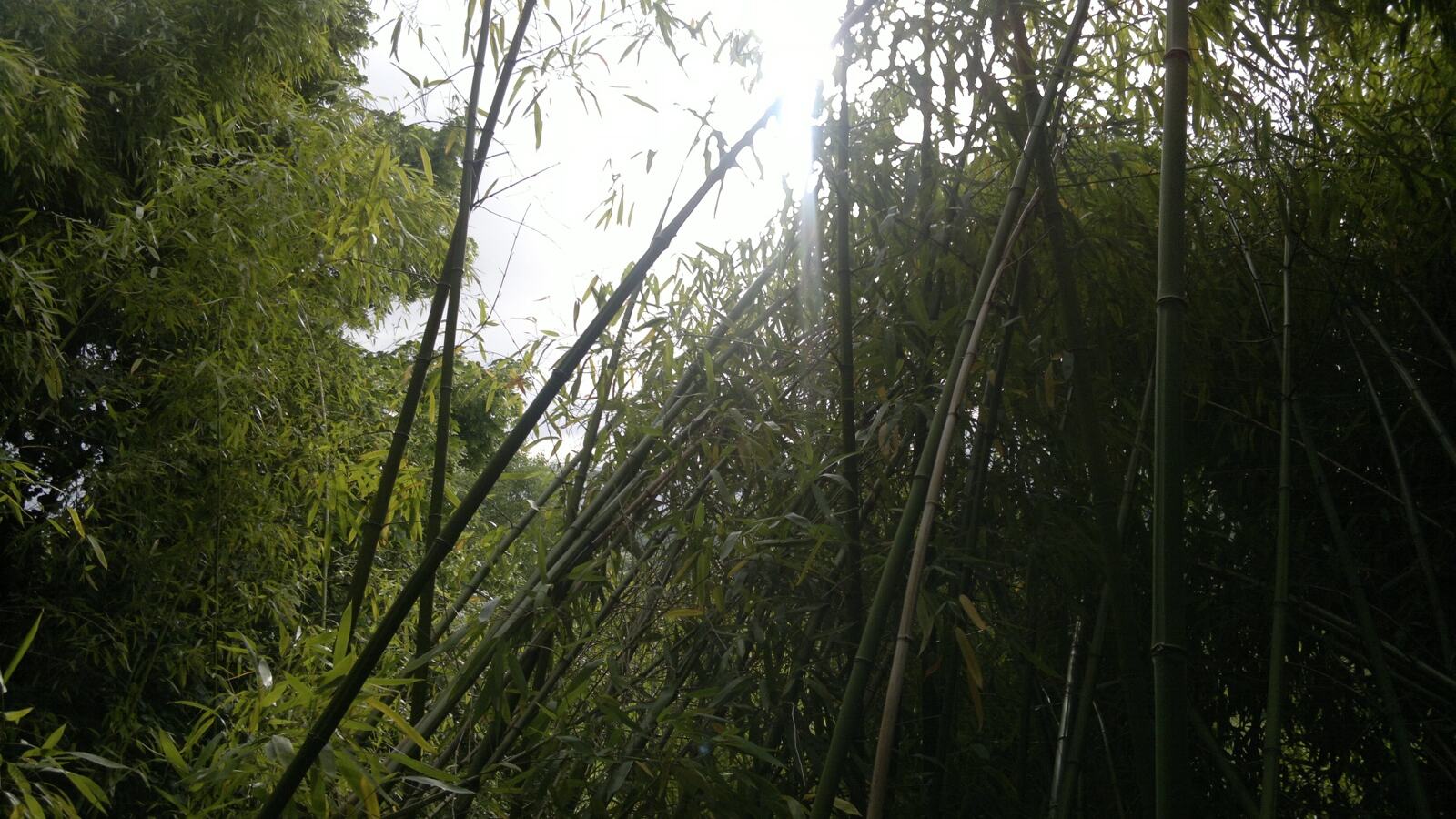
What it is
A grass. Around 1,500 species of woody grasses in the subfamily Bambusoideae, from ground-cover species a few centimetres high to giants over 30 m with culms 30 cm across.
Everything unusual about bamboo follows from being a grass rather than a tree. It has no cambium, so a culm never thickens after it emerges. It grows from nodes along the stem rather than from a single growing tip. And it spreads by rhizome, so a grove is usually one connected organism.
The speed
Bamboo is the fastest-growing plant on earth, and the figures are genuinely extreme. Some species have been recorded growing over 90 cm in a day, and moso bamboo can reach 20 m in a couple of months.
The mechanism is that a culm emerges at its final diameter and simply extends. All the cells are already present in the shoot; growth is elongation of pre-formed segments, powered by the rhizome network of the whole grove. The new culm is a withdrawal from a shared account.
A culm reaches full height in one season, then spends three to five years hardening as lignin and silica accumulate. It never grows taller or thicker again.
This means harvest is selective and continuous rather than a clear-fell. Culms are cut at 3 to 5 years old, when strength peaks, while the grove keeps producing new ones every year. A managed grove yields annually and indefinitely without ever being cleared, which is a genuinely unusual property for a structural material.
Running versus clumping
The distinction that decides whether planting bamboo is sensible or a permanent regret.
Clumping, sympodial. Rhizomes are short and turn upward immediately, so the plant expands slowly outward as a tight clump. Predictable and safe to plant. Mostly tropical: Bambusa, Dendrocalamus, Fargesia among the hardy ones.
Running, monopodial. Rhizomes travel horizontally, sometimes many metres a year, sending up culms wherever they go. Mostly temperate: Phyllostachys, Sasa, Pleioblastus.
Running bamboo will cross a garden, come up in a neighbour's lawn, and lift paving. In several countries it has become a serious invasive problem and a source of legal disputes, and removal is genuinely difficult once established. See invasive species.
If you plant a running species, install a proper rhizome barrier: a rigid HDPE membrane at least 60 to 80 cm deep, angled outward at the top so rhizomes are deflected to the surface where they can be seen and cut. Check the perimeter annually. Alternatively grow it in a large container.
For most gardens, plant clumping species and avoid the problem entirely.
Building with it
Bamboo has a tensile strength comparable to mild steel and a strength-to-weight ratio that outperforms most timber and concrete. It has been a primary structural material across Asia and South America for millennia, and engineered bamboo is now used in genuinely serious modern construction.
The requirements for durable bamboo construction are specific:
Harvest at the right age, 3 to 5 years, and ideally in the dry season when starch content is lowest.
Treat it. Untreated bamboo is destroyed by powderpost beetles and fungi within a few years. Treatment ranges from traditional water leaching and smoke curing to borax-boric acid diffusion, which is cheap, effective, and low in toxicity.
Keep it dry and off the ground. The traditional design principle is good boots and a good hat: a raised foundation and a generous roof overhang. Bamboo protected from ground contact and rain lasts for decades.
Detail the joints properly. Bamboo is strong along the culm and splits easily across it, so traditional joinery uses lashings, through-bolts with fitted plugs, and fish-mouth cuts rather than nails.
Engineered products, laminated bamboo boards and strand-woven flooring, behave like dense hardwood and are used in flooring, panels, and structural beams.
Carbon and land
Bamboo is frequently promoted as a climate solution, and the honest picture is genuinely good with some caveats.
The positives: very high biomass productivity, annual harvest without clearing, an intact root system that keeps holding soil and carbon between harvests, and a durable product that stores carbon for the life of the building.
The caveat is that carbon in bamboo is stored briefly unless it goes into long-lived products. Bamboo used for disposable goods sequesters nothing meaningful. And bamboo plantations established by clearing natural forest are a net loss, exactly as with any other plantation crop. See carbon accounting.
Erosion control and slopes
The rhizome network is dense, fibrous, and shallow, and it binds soil extremely effectively.
Bamboo is used across Asia for stabilising riverbanks, gully heads, and steep slopes, and it establishes fast enough to hold ground within a couple of seasons rather than a decade. On degraded and landslide-prone slopes it is one of the quickest stabilising options available.
It also grows readily on poor and degraded soil, which makes it useful on sites where little else will establish. See erosion control and riparian buffers, while noting that a running species near a watercourse can spread downstream from fragments.
Flowering, and mass death
One of the strangest life cycles in the plant kingdom.
Most bamboos flower gregariously: every plant of a species, across an entire region and regardless of when or where it was planted, flowers in the same year. The interval varies by species and can be anywhere from 30 to 120 years or more. After flowering and setting seed, the plants die.
Because clones share the flowering clock, plants propagated from a single stock and distributed worldwide will flower and die simultaneously on different continents.
The consequences are real. In north-east India, the mass flowering of Melocanna baccifera roughly every 48 years produces an enormous seed crop, a rat population explosion, and subsequent famine as the rats move into crops, an event with its own name, mautam. Giant panda populations have been threatened by simultaneous die-off of their food species.
Practically, it means a bamboo grove can die suddenly for reasons entirely unrelated to how it was managed, and it means seed is rarely available.
Growing it
Most bamboos want moist, well-drained, fertile soil and shelter from cold drying wind, which scorches the leaves.
Feed them. Bamboo is a grass and responds strongly to nitrogen. A mulch of its own fallen leaves recycles the silica it needs and should be left in place. See chop and drop.
Thin the grove annually, removing the oldest culms to keep light in and vigour up. An unthinned grove becomes congested and produces progressively thinner culms.
Shoots of many species are edible, though most need boiling to remove cyanogenic compounds, and some species are far better eating than others.
And decide the running-versus-clumping question before you plant, not afterwards.
See also
- Erosion Control bamboo for slope stabilisation
- Invasive Species running bamboo as a problem
- Carbon Accounting assessing the climate claims
- Coppice Rotation the comparable cut-and-regrow system
- Riparian Buffers bank stabilisation
- Chop and Drop recycling the leaf litter