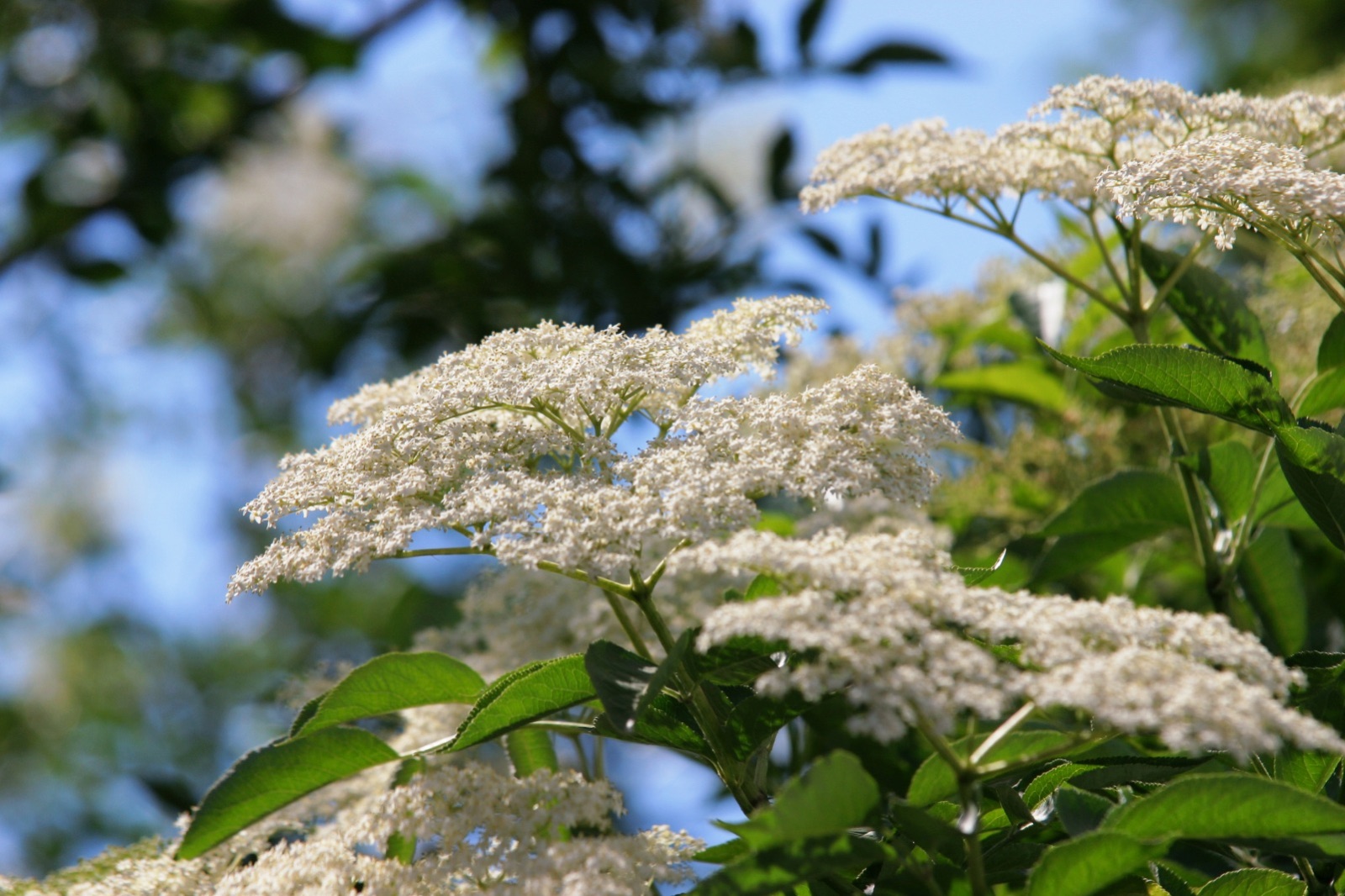
What it is
A fast, scruffy shrub with hollow stems and a fifty-year career.
Two species do most of the work. Sambucus nigra, the European elder, reaches 6 to 8 m across Europe and western Asia. Sambucus canadensis, the American elder, stays at 3 to 4 m from Nova Scotia to Texas. Botanists now lump canadensis as a subspecies of nigra. In the field they behave almost identically: same flat white umbels in early summer, same dark purple drupes by August.
Old hedgerow elders in Kent are still cropping at 60 years old. A long lease for a plant most people treat as a weed.
Why it earns the space
Elder is a keystone. The flat umbels feed hoverflies, solitary bees, and wasps when little else is open. By August the berries pull in 20-plus bird species: blackcaps, thrushes, starlings, waxwings, robins. The seeds pass through and get planted with a fertiliser packet attached. See Seed-Dispersing Birds for the mechanics.
For the grower the case is simpler. The flowers make cordial. The berries make syrup, tincture, wine, and a folk antiviral with real clinical data behind it. Anthocyanin content runs 200 to 800 mg per 100 g of fresh berry, which is roughly twice that of blueberries.
The shrub also coppices hard. Cut it to a stump in winter and it throws 2 m of new growth by July. That makes it a productive chop and drop candidate in a young system.
Propagate it
Forget seed. Cuttings are how elder moves.
Take hardwood cuttings between December and February. Pick pencil-thick wood from last year's growth. Cut sections 25 to 30 cm long. Flat cut at the top, angled at the bottom, so you remember which end is up.
Push them two-thirds deep into a nursery bed of free-draining soil. Spacing 15 cm. Leave one or two buds above ground. No hormone needed. Water once, then leave them alone until spring.
Strike rate runs 70 to 90 percent. By the following autumn you have rooted whips for a hedge line. This is how you build a 100-metre mixed hedge from one mother plant in two seasons. Softwood cuttings in June also work but rot easily. Stick to winter wood.
Where to plant it
Full sun gives the biggest crop. Part shade still produces. Elder tolerates everything from heavy clay to gravelly bank, and it shrugs off short waterlogging that would kill a hawthorn.
It pairs well in mixed hedge. Run elder with hawthorn, hazel, blackthorn, dog rose, and a willow or two for the wet end. Plant on a 45 cm spacing in a double staggered row. Inside three years you have a stockproof, bird-loud, flower-loaded hedgerow.
Do not plant it under a dripline of mature walnut. Juglone knocks young elder back. See Walnut for the allelopathy story.
In a food forest, slot elder into the shrub layer at the wet edge of the system, near a swale or a seasonal damp spot. The roots will not mind.
Harvest it
Flowers. Cut whole umbels in the morning of a dry day, just after the buds open and before the petals start dropping. The scent should be sweet and faintly muscat. If it smells of cat or sour milk you have waited too long. Use within hours. A 5 kg flower haul makes about 12 litres of cordial.
Berries. Pick when the entire umbel hangs heavy and the stems blush red-purple. Underripe berries are green and stay toxic longer. Strip with a fork: drag the tines through the umbel and the ripe berries pop off into a bowl. Discard stems, leaves, and any green fruit.
A mature Sambucus nigra yields 8 to 15 kg of fresh berry per year. Process within 24 hours. Freeze if you cannot.
The cyanide caveat
Every green part of the plant and every raw berry contains cyanogenic glycosides, mostly sambunigrin. Eat enough raw fruit and you get nausea, vomiting, diarrhoea, and in rare cases worse. Children have been hospitalised after juicing raw berries through a press that pulled in stems and leaves.
Cooking destroys it. Bring berries to a rolling simmer for 15 to 20 minutes and the glycosides break down. Tincture with 40 percent alcohol for at least four weeks and the same thing happens. Dried berries are also safe once fully dry.
The rules are simple. Cook the berries. Never use the leaves, bark, or roots for anything you ingest. Strip stems out before processing. Sambucus racemosa, the red elder, has higher toxin loads and should be left to the birds.
Cultivars worth knowing
'Adams'. A canadensis cultivar selected in New York around 1926. Large berries, heavy yield, vigorous. The default for American hedgerows and small plantings.
'York'. Also canadensis, slightly later than 'Adams' and a touch larger fruited. Plant the two together for cross-pollination and yields jump 30 to 50 percent over either alone.
'Haschberg'. Austrian nigra cultivar, the workhorse of European commercial elderberry. Reliable cropper, good for syrup and wine.
'Black Lace' and 'Black Beauty'. Ornamental nigra with deep purple foliage. Crops are smaller. Plant for the look, not the larder.
Two cultivars in a planting always outperform one. Elder is partially self-fertile but cross-pollination is where the real yield lives.
When it goes wrong
No berries despite heavy flower. Lone plant, or a single cultivar block. Add a second cultivar within 15 m and wait a year.
Stems suddenly die back in summer. Likely elder borer or stem canker. Cut affected canes to the base, burn them, and the shrub will regrow from the crown.
Birds strip everything before you pick. Net the most accessible bush. Leave the rest for them. This is rent, not theft.
Suckers everywhere. Elder spreads. Mow a 1 m margin around the planting once a year or use it as a coppice block and let it do its thing.