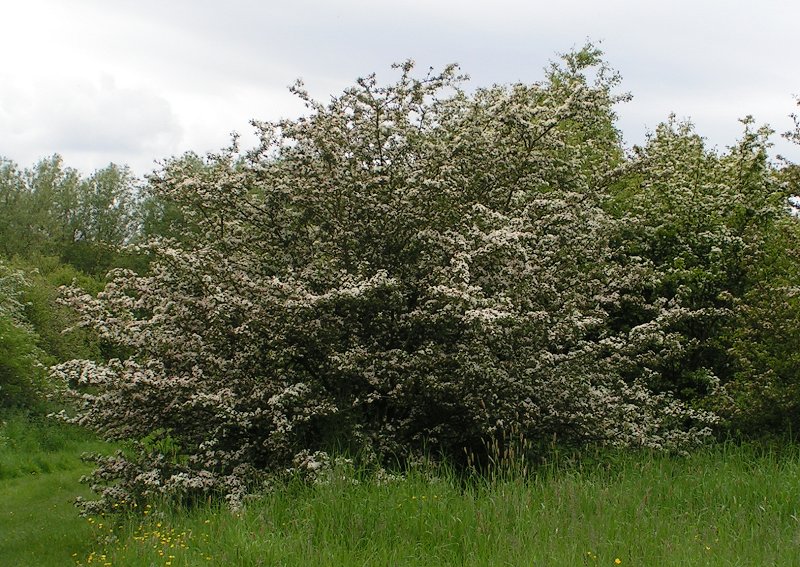
What it is
A small thorned tree that wants to be a hedge.
Crataegus monogyna is the European workhorse, but the genus runs to roughly 280 species across the northern hemisphere. C. laevigata (Midland hawthorn) in older British woods. C. crus-galli and C. phaenopyrum through the eastern US. C. azarolus in the Mediterranean for the larger fruit.
It grows 6 to 10 meters left alone, lives 300 years easily, and the Hethel Old Thorn in Norfolk has been carbon-dated past 700. Slow above ground. Patient below.
The thorns are not decorative. They are modified short shoots, 1 to 4 cm long, and they make the plant the best living fence in the temperate world.
Why it works
A mature hawthorn hedge is four things at once.
A wildlife block. Dense ramification (lots of small twigs branching tightly) creates the cover thrushes, finches, and yellowhammers need in open country. British hedgerow surveys log 65 bird species using hawthorn as primary nesting habitat. The thorns keep cats and corvids out of the nest cup.
A pollinator pulse. The white May blossom opens for two to three weeks and feeds everything with wings. Honey bees, solitary bees, hoverflies, beetles. The scent is strong, slightly fishy, unmistakable in a country lane in May.
A fruit larder. Red haws ripen September to November and hang on the bush through hard frost. Blackbirds, fieldfares, redwings, mistle thrushes strip them between November and February when nothing else is left. The seed germinates better after passing through a bird gut.
A windbreak with teeth. Stock will not push through a properly laid hawthorn hedge. Sheep, cattle, deer all respect it. The English enclosures of the 18th and 19th centuries planted hawthorn by the million. "Quickthorn" was the nursery name.
Plant it
For a hedge: bare-root whips, 40 to 60 cm tall, planted November to March while dormant.
Density. 5 to 7 plants per linear meter in a double staggered row. Rows 30 cm apart. Plants 25 to 33 cm apart within the row. Closer if you want a stockproof line fast. Wider on poor ground.
The trench. Dig a slot 30 cm deep and 40 cm wide. Loosen the base. Score the sides of any glazed clay. Drop the whips in, firm with your heel, water once.
Mix the species. A pure hawthorn hedge works, but a classic mixed hedge runs 60 to 70 percent hawthorn with blackthorn, hazel, field maple, dog rose, elderberry, guelder rose, and the odd holly threaded through. More flowering weeks. More berries through winter. More species using it.
Cut it back hard. Trim the whips to 15 to 20 cm after planting. This forces low branching. A hawthorn hedge that was not cut hard at year one will always have a leggy base, and a leggy base is not stockproof.
Mulch heavily for the first two seasons. See soil cover and mulch for moisture.
Tend it
For the first three years, treat it like a young orchard. Water in droughts. Keep grass off the base. Replace failures the next dormant season.
From year four, start trimming. An A-shape profile, wider at the base than the top, lets light reach the bottom branches and keeps the hedge dense to the ground. Trim in late winter, after the berries are gone but before nesting starts. Never trim May to August. You will destroy active nests, and in the UK it is illegal under the Wildlife and Countryside Act.
Hedge-laying. Every 15 to 25 years a hawthorn hedge wants laying. You cut three quarters of the way through each stem at the base (the pleacher), bend it over at a low angle, and weave it between stakes. The bark on the uncut side keeps living tissue moving. Spring growth comes up vertical from the laid stems and you get a stockproof, regenerated hedge for another generation. Midland, Devon, and Welsh styles differ. Find a local hedger and learn the one for your county.
Coppice in extremis. A neglected hawthorn cut to a 15 cm stool will throw vigorous regrowth and rebuild in five years.
The haws
Pick after the first hard frost. Cold breaks down the astringency and concentrates the sugars. Raw they are mealy and dull, like a dry apple. Cooked or tinctured they earn their keep.
Hawthorn jelly with crab apple is the traditional British use. Equal weights of haws and crabs, simmer, strain, add sugar.
Cardiac tincture. Crataegus is one of the few herbal medicines with serious clinical backing. Standardized extracts of leaf, flower, and berry improve exercise tolerance in mild chronic heart failure across multiple trials. The active constituents are oligomeric procyanidins and flavonoids. Traditional preparation is a 1:5 tincture in 40 percent alcohol of May flowering tops plus October berries, dose 2.5 to 5 ml three times daily. Talk to a herbalist or cardiologist before mixing it with prescribed cardiac drugs.
The seed holds cyanogenic compounds. Do not crush and ingest the pip.
When it goes wrong
Fireblight (Erwinia amylovora). A bacterial disease that browns tips overnight, "shepherd's crook" wilt, dark cankers on the stem. Cut affected wood back 30 cm into healthy tissue and burn it. Sterilize tools between cuts. Worst in warm humid springs after wet blossom.
Hawthorn rust. Orange spots on leaves, often after a juniper has come in nearby. The fungus alternates between hawthorn and juniper hosts. Rarely fatal. Tolerate it.
Browsing knocks new whips back. Deer and rabbits will graze a young hedge to nothing. Tree guards or a temporary rabbit fence for the first three years. Once the thorns harden, the hedge defends itself.
Hedge gone leggy. You skipped the year-one hard cut, or trimmed too high too long. Lay it or coppice it. Hawthorn forgives almost any cut.
A planted hawthorn hedge is a hundred-year investment that pays from year five. There are very few projects on a working farm with that ratio.