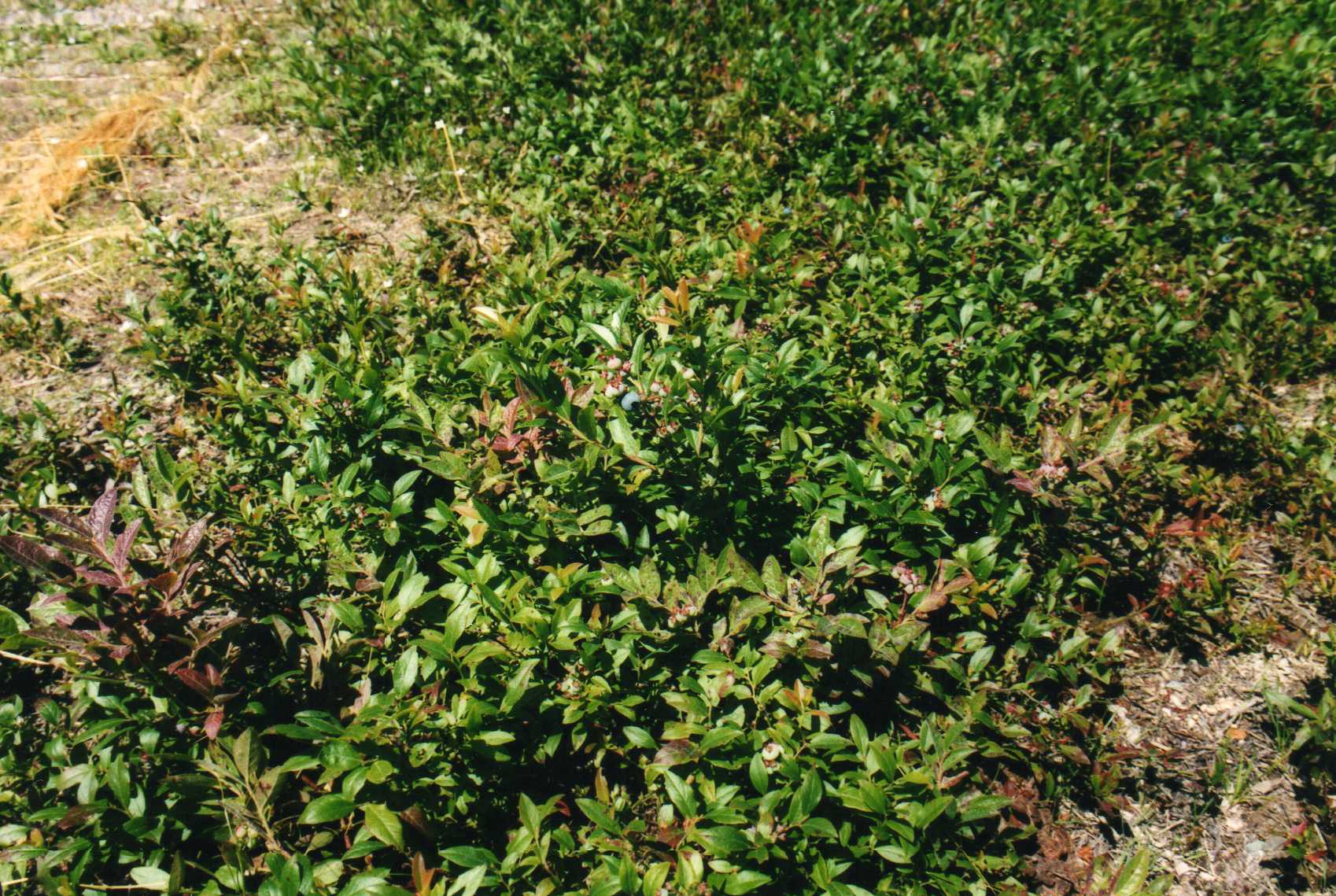
What they are
Blueberries are Vaccinium. The genus runs to around 450 species, most of them shrubs of cool, acid, peaty ground.
Four groups matter for growers. Lowbush (V. angustifolium) sprawls 30 cm tall across Maine and Quebec barrens, spread by rhizomes, harvested with rakes. Highbush (V. corymbosum) hits 1.5 to 2.5 m and supplies most of the commercial crop. Rabbiteye (V. virgatum) tolerates heat down through Georgia and Florida, grows to 3 m, ripens late. Half-high hybrids cross lowbush and highbush for cold-climate gardens, topping out around 1 m.
Pick the one that matches your winter. Highbush wants 800 to 1000 chill hours. Rabbiteye wants 350 to 600. Plant the wrong one and you get a green shrub that never fruits.
Why pH rules everything
Vaccinium evolved on peat and decomposing conifer duff. Soil pH 4.0 to 5.2. Above 5.5, iron and manganese lock up, leaves yellow between the veins, and the plant slowly starves on ground that looks fine to a tomato.
The partnership is ericoid mycorrhiza, not the arbuscular fungi that feed most crops. Rhizoscyphus ericae and its relatives colonise the hair-thin Vaccinium roots and pull nitrogen straight from raw organic matter. They thrive in acid, oxygen-poor peat. Lime the bed and the fungi collapse first, then the shrub.
This is why blueberries are not a compost-and-go crop. The biology is a different lineage. See Mycorrhizal Fungi for the broader picture.
Build the bed
Test the soil first. A cheap probe meter gets you close. A lab test gets you exact. See Soil Testing.
If your soil sits at pH 6.5, you have work to do. Elemental sulfur is the standard amendment. Rough rates for a sandy loam: 100 g per square meter drops pH by roughly 0.5 units over six months. For heavy clay, double it. Apply the autumn before planting, work it into the top 20 cm, and let soil bacteria oxidise it slowly to sulfuric acid.
Aluminum sulfate works faster but salts up the soil and can poison ericoid fungi at heavy rates. Skip it.
The faster route on alkaline ground: build up, not down. Dig a pit 60 cm deep and 1 m across. Backfill with one-third peat moss (or coir for the peat-bog-conscious), one-third sharp sand, one-third native soil. Mix in 50 g of sulfur. Top with 10 cm of aged pine bark or pine needle mulch. You have built a perched acid pocket the plant will live in for two decades.
Plant in early spring or autumn. Set the crown 2 cm proud of finished grade. Water in with rainwater or stored runoff. Tap water in hard-water regions can run pH 7.5 and undo the bed in a season.
The companion shelf
A pH 4.5 bed is a chance to plant a whole acid-loving guild, not just blueberries.
Rhododendron and azalea share the fungal partners and the soil chemistry. Use them as the structural backbone in a mixed bed.
Mountain laurel (Kalmia latifolia) handles deep shade at the edge.
Andromeda (Pieris japonica) fills the early-spring nectar gap for queen bumblebees emerging from hibernation.
Cranberry (V. macrocarpon) carpets the wet edge. It wants pH 4.0 to 5.0 and a season of standing water.
Lingonberry (V. vitis-idaea) is the evergreen groundcover under taller shrubs. Two crops a year in cool climates.
Plant them together and you get cascading bloom from March to June, two berry harvests, and a stand of evergreen foliage that holds the bed in winter. See Companion Planting Guide.
Tend it
Mulch heavy. 10 to 15 cm of pine needles, aged pine bark, or sawdust from untreated softwood. Refresh every autumn. The mulch acidifies as it breaks down and shelters the shallow roots.
Vaccinium roots sit in the top 30 cm. They are fine, brittle, and intolerant of drought. Drip irrigation or ollas work better than overhead spray. One bucket per week per mature bush in dry stretches. Use captured rainwater.
Feed with acidifying fertilizers. Cottonseed meal, soybean meal, and fish emulsion all push pH slightly down while supplying nitrogen as ammonium, the form ericoid fungi prefer. Skip wood ash, dolomite, and any feed with calcium nitrate.
Prune in late winter. Highbush: remove the oldest 20 percent of canes each year on plants over six years old. New canes from the crown carry next year's crop. Rabbiteye: lighter pruning, mostly thinning. Lowbush: mow or burn one-third of the patch each year on a three-year rotation. The Wabanaki and other Northeastern peoples ran lowbush stands this way for centuries.
A bush hits full production around year five and stays there for 20 to 30 years if the soil holds.
When it goes wrong
Yellow leaves with green veins. Iron chlorosis. The pH crept up. Drench with chelated iron for the season, then top-dress with 50 g of sulfur per square meter and a fresh layer of pine needle mulch.
No fruit set despite good bloom. One of three things. Wrong chill hours for your cultivar. No second variety for cross-pollination (most cultivars want a partner). Or no pollinators. Plant a second cultivar within 15 m and seed a strip of early-blooming natives for the native bees.
Birds strip the crop in a week. They will. Netting is the only reliable answer. Drape it before color break, anchor it at the ground, and check it daily for tangled birds.
The bed creeps back to neutral. Hard water, calcium-rich dust, decomposed mulch. Re-test every two years. Top-dress with 30 g of sulfur per square meter as maintenance. Switch irrigation to rainwater if you have not already.
Crown rot after a wet winter. Drainage failed. Lift the bed, add coarse sand or pine bark to the planting mix, and replant on a slight mound.