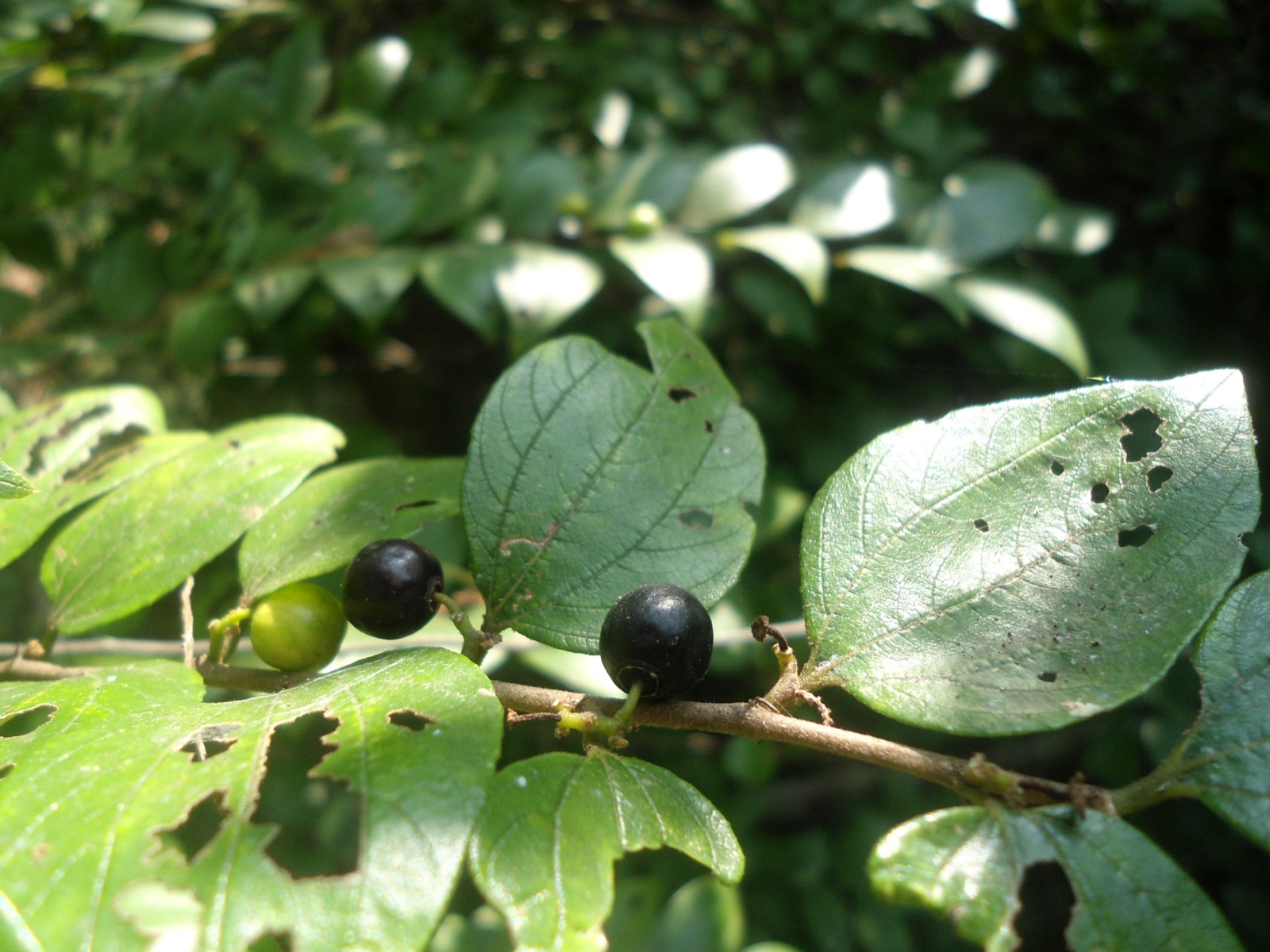
What they are
Five shrubs. One hedge.
Viburnum opulus (guelder rose) for translucent red berries that hang past Christmas. Viburnum lantana (wayfaring tree) for chalk-tolerant cover and black drupes. Cornus sanguinea (common dogwood) and Cornus sericea (red-osier) for blazing winter stems. Ilex aquifolium (holly) for evergreen shelter and late food. Prunus spinosa (blackthorn) for the thorny tangle that keeps small birds safe from cats and sparrowhawks.
Plant them together. A single-species hedge feeds the wrong things at the wrong time. A mix feeds something every month.
Why the mix matters
Each species fills a different gap in the calendar.
Blackthorn flowers in March, before its own leaves break. Those white blossoms are the first major nectar source for queen bumblebees coming out of hibernation. Guelder rose follows in May with flat lacecap flowers that hoverflies and small beetles work hard. Dogwood blooms in June. By the time holly opens its tiny white flowers in late spring, the hedge has fed pollinators for three straight months.
Then the berries take over. Dogwood drupes ripen black in August. Wayfaring tree turns red then black through September. Guelder rose holds bright red clusters from October into January, when fieldfares and redwings arrive from Scandinavia and strip them in days. Holly berries are the late insurance: bitter, slow to ripen, and ignored until February when nothing else is left.
Blackthorn sloes hang on past the first frosts. Frost softens the tannins. Thrushes take them through November.
The structural jobs
Berries get the attention. The structure does the harder work.
Spine density. Blackthorn grows dense, low, and viciously thorny. A three-year-old blackthorn thicket is impassable to a cat and difficult for a magpie to push through. That is exactly the cover a dunnock or wren needs to nest. Aim for blackthorn in at least 30 percent of the hedge length where you want nesting birds.
Evergreen cover. Holly holds its leaves through winter storms. Roosting thrushes, wrens, and goldcrests pile into a mature holly in January. Plant holly every 8 to 10 meters along the run. One mature plant per stretch is enough.
Winter stem color. Cornus sericea throws red one-year stems. Cornus sanguinea 'Midwinter Fire' runs orange to yellow to red along a single stem. The color is on new growth, so coppice a third of the dogwood stems to the base every winter to keep the display bright. Old wood goes dull brown.
Plant it
Bare-root whips, November to March, 60 to 90 cm tall, two years old. Cheaper than potted by a factor of five, and they establish faster.
Space at five plants per meter in a double staggered row, rows 40 cm apart. That gets you a stockproof hedge in four years and a bird hedge in two.
A working mix for 100 meters of new hedge:
- 200 blackthorn (40 percent, the thorny backbone)
- 100 hawthorn (20 percent, for berries and bee food, see Hawthorn)
- 75 guelder rose
- 50 dogwood (split between C. sanguinea and C. sericea)
- 50 wayfaring tree (drop this on acid soil, double the dogwood instead)
- 25 holly, spaced evenly down the run
Mulch heavily after planting. A 10 cm layer of wood chip over cardboard kills the grass that would otherwise strangle the whips in year one. See Soil Cover.
Water deeply once a week through the first summer. After that the hedge is on its own.
Tend it
Do not flail every winter. A hedge cut hard each year never sets berries. Cut a third on rotation: one third hard, one third trimmed, one third left alone. Run the rotation across three winters. You always have flowers and fruit somewhere along the line.
Cut between late January and the end of February. Earlier and you waste berries the thrushes still want. Later and you start hitting nesting birds, which is illegal in the UK from March to August.
Coppice dogwood stools to 15 cm every two or three winters. The new red whips that come up are what you planted them for.
Holly needs nothing. Leave it.
Blackthorn suckers. Hard. If you do not want a 3 m wide thicket, run a mower along the field edge once a year to knock back the suckers heading out into the pasture.
When it goes wrong
No berries on the guelder rose. Late frost killed the May flowers. Common in low-lying ground where cold air pools. Plant guelder rose on the higher end of the hedge run, or pair it with windbreak species that lift the frost line.
The dogwood goes dull. You stopped coppicing. Cut a third to the base this winter. Color returns next year.
Holly never sets berries. Holly is dioecious. You planted all males, or all females, or your one female has no male within pollinator range. Buy named cultivars: 'J.C. van Tol' is self-fertile and reliable. Otherwise plant one male per five females.
Blackthorn takes over. That is what blackthorn does. Decide at planting whether you want a hedge or a thicket, and place blackthorn accordingly. In a wildlife corridor, let it run. Along a vegetable garden, plant hawthorn and holly closer to the cropping side and keep blackthorn at the far end.
Deer browse the new whips to stumps. Tree guards on every plant for the first three years. See Deer and Rabbits for the full barrier playbook.
A hedge built this way is a long bet. Three years to cover. Five to fruit. Twenty to maturity. The fieldfares come anyway, and they remember.
See also
- Hawthorn, the sixth shrub most mixes need
- Seed-Dispersing Birds, who plant the next generation for you
- Pollinator Habitat, scaling the bee food beyond the hedge
- Wildlife Corridors, connecting hedgerows across a landscape
- Native Plant Selection, choosing the regional version of this mix