What it is
Aralia spinosa, the devil's walking stick or Hercules' club — a small, suckering, viciously spiny tree of the eastern United States, and one of the most dramatic and distinctive of native temperate trees.
It belongs to the ivy and ginseng family, Araliaceae (a relative of English ivy and of ginseng), and it is unmistakable for three things: it is armed all over with sharp spines, it carries enormous leaves, and it produces gigantic flower heads in late summer. It typically grows as a sparse, few-branched, spiny pole or small tree, spreading into thickets by suckers.
Spines and giant leaves
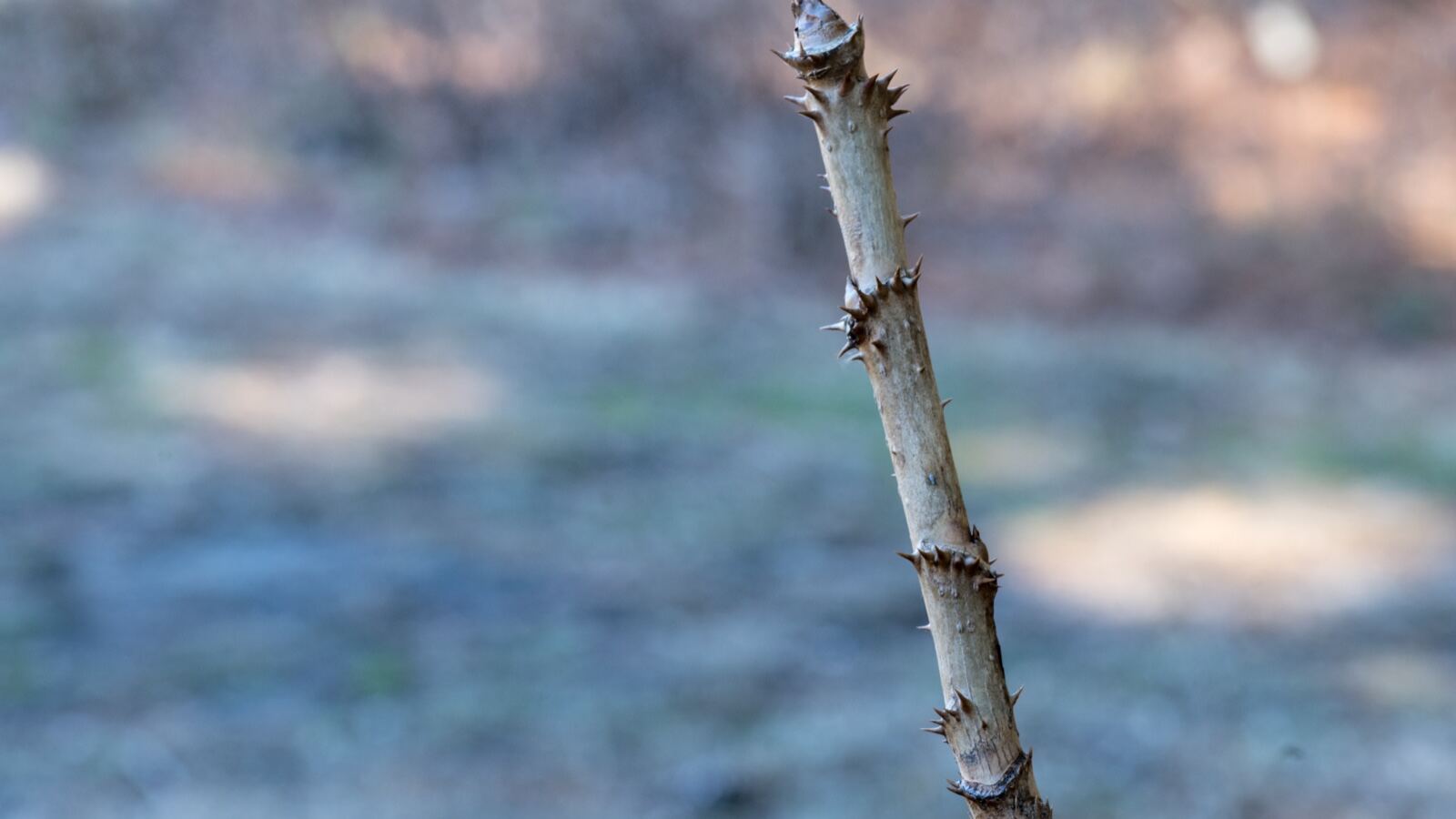
The devil's walking stick is one of the most heavily armed of temperate trees. Its trunk, branches, and even its leaf-stalks are set with stout, sharp spines, so that the whole plant is a formidable, painful thing to grasp — hence "devil's walking stick" (a walking stick no devil would want to hold, or exactly the one he would) and "Hercules' club." The spines deter browsing and climbing.
It also carries some of the largest leaves of any temperate tree. Each leaf is enormous — bipinnately or tripinnately compound, up to a metre or more long and nearly as wide, divided into many leaflets — among the largest leaves (by this compound measure) of any tree in North America, in the league of the Kentucky coffeetree. Held in a whorl at the top of the sparse spiny stems, they give the plant a strange, tropical, umbrella-like look quite unlike anything else in the temperate woods, and they turn yellow, orange, and purple in autumn.
Flowers, berries, and wildlife
In late summer, when the huge leaves are fully out, the devil's walking stick throws up vast, frothy, branching flower heads — great domed panicles of tiny creamy-white flowers, sometimes a metre across, held above the foliage. Coming late in the season, these are an outstanding nectar and pollen source, and a flowering Hercules' club hums with bees, wasps, flies, butterflies, and other pollinators — one of the best late-summer insect plants of the eastern forest edge. See pollinator habitat and native bees.
The flowers give way to masses of small purple-black berries on pink-red stalks, which are eagerly eaten by birds and other wildlife in autumn, and the dense spiny thickets give cover, making it a valuable wildlife plant of the woodland edge and clearing. See seed-dispersing birds and structural diversity. (The berries and other parts are toxic to people, and the plant has a history of cautious medicinal use, like several Araliaceae.)
Growing it
Hardy and adaptable, the devil's walking stick is a tough native of woodland edges, clearings, and disturbed ground, wanting sun or part shade and tolerating a range of soils, including poor and dry ground; it suckers freely and can form thickets, so it is best given room to spread or sited where suckers can be managed.
It is grown as a bold, architectural, late-flowering ornamental and wildlife plant — striking for its spines, its giant tropical-looking leaves, its huge flower heads, and its autumn colour and berries — and is propagated easily from seed, suckers, and root cuttings. For a wild or naturalistic planting, or a dramatic accent, it is one of the most distinctive of native small trees, best planted where its spines are out of the way. See propagation and wildlife shrubs.
See also
- Kentucky Coffeetree another temperate tree of enormous compound leaves
- Pollinator Habitat and Native Bees the late-summer insect feast
- Seed-Dispersing Birds the birds that eat its berries
- Structural Diversity the woodland-edge layer it occupies
- Wildlife Shrubs the devil's walking stick in a wildlife planting
- Sumac and Smoke Tree another suckering, bold-foliaged native