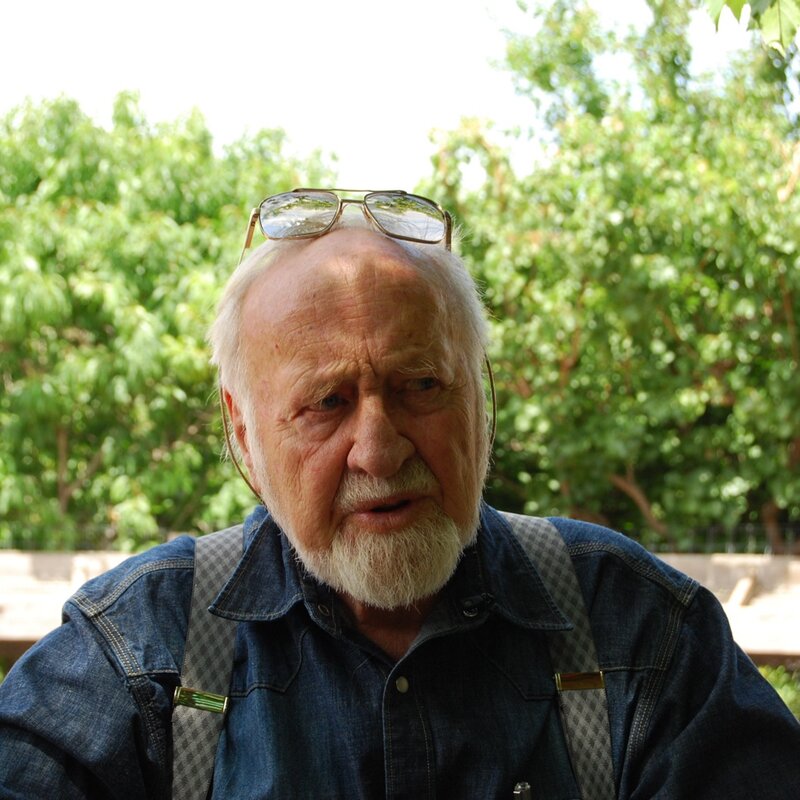
The Bush Education
Bruce Charles Mollison was born in 1928 in Stanley, a small fishing town in northwest Tasmania. He left school at fifteen.
What followed was not an academic apprenticeship but a practical one. He worked as a baker, a shark fisherman, a seaman, a forester, a mill worker, and a trapper. He spent years in the Tasmanian bush, and he learned the country by watching it work.
That period mattered more than any qualification he later collected. Mollison developed an unusually detailed field knowledge of how natural systems assembled themselves: which species followed which, how water moved, where things grew and why.
In 1954 he joined the CSIRO, Australia's national science agency, in the Wildlife Survey Section. He later worked in the Tasmanian Inland Fisheries Department, and eventually took a position teaching at the University of Tasmania, where he developed the environmental psychology unit.
Watching Systems Fail
Through the 1960s and early 1970s, Mollison's fieldwork showed him something he found intolerable. The systems he had been documenting were disappearing.
He watched fisheries collapse, forests cleared, soils erode, and rivers degrade. He became active in protest movements and found the experience hollow. Opposition, he concluded, was insufficient. It described what was wrong without proposing what should replace it.
In 1974 he stopped protesting and started designing.
The Collaboration
At the University of Tasmania, Mollison met David Holmgren, then a young student in environmental design. The two began working out a systematic alternative to industrial agriculture.
Their starting point was the observation that annual monoculture cropping was inherently unstable. It required continuous energy input, destroyed soil, and depended on inputs that could not last. A forest, by contrast, produced abundantly, built soil, and required nothing from anyone.
The question was whether agriculture could be designed to behave like a forest.
Their answer was permanent agriculture, shortened to permaculture. Holmgren wrote the manuscript that became Permaculture One, published under both names in 1978, and the term entered circulation.
The system's foundation is that yields come from the relationships between elements, not from the elements themselves. A pond beside a glasshouse beside a chicken run is a different proposition from those three things in separate corners of a property. Design, in this framework, means arranging components so their outputs meet each other's needs.
From this came the tools that remain the core of the method: zones organised by visit frequency, sector analysis of incoming energies, and the sequence that puts water and access before anything else.
Teaching as Strategy
Mollison's decisive choice was not the design system. It was how he distributed it.
He concluded that publishing books and consulting would never move fast enough. Instead he created the Permaculture Design Certificate, a 72-hour course, and made a deliberate arrangement: anyone who completed it could teach it themselves.
This was unusual and consequential. He gave away the intellectual property in exchange for replication, and permaculture spread as a self-propagating network rather than an institution.
From 1979 he taught relentlessly, travelling to more than 80 countries. He founded the Permaculture Institute in Tasmania in 1979 and published Permaculture: A Designers' Manual in 1988, which remains the reference text.
By the time of his death, the certificate had been taught in over 140 countries to hundreds of thousands of people. Among those he taught and worked alongside was Geoff Lawton, who carried the earthworks and drylands side of the work forward.
In 1981 he received the Right Livelihood Award, often described as the alternative Nobel.
The Character
Mollison was abrasive, funny, and profoundly uninterested in diplomacy. He described himself as a very negative person working positively, and he was quick to dismiss institutions, academics, and governments.
He was also frequently accused, with some justification, of overstating claims and of resisting the scientific scrutiny that would have tested them. Permaculture's uneven relationship with formal research owes something to his temperament.
What is not in dispute is the reach. A design vocabulary invented by two people in Tasmania is now used on every continent, in climates from the Sahel to Scandinavia, mostly by people who never met either of them.
What He Actually Changed
Before permaculture, alternative agriculture consisted of scattered techniques: composting, mulching, companion planting, each argued for on its own terms.
Mollison's contribution was to supply a framework that connected them, and a set of design questions that could be applied anywhere. That is why the system travelled so well across climates: he exported a method rather than a recipe.
Nearly every technique in this encyclopedia has a place in that framework. Food forests, swales, keyline planning, guilds, chop and drop, and greywater systems are all things permaculture assembled into a coherent whole rather than invented.
Mollison died in Sisters Creek, Tasmania, in September 2016, at 88.
His central instruction was simpler than the system that grew from it: stop fighting what is wrong, and build the thing that should replace it.
See also
- David Holmgren the co-originator
- Geoff Lawton who carried the teaching forward
- Permaculture Design the framework itself
- Food Forest Design the flagship application
- Masanobu Fukuoka a parallel conclusion from another direction