What it is
Arbutus unedo, a small evergreen tree of the Mediterranean and, unusually, western Ireland — one of the "Lusitanian" species with a scattered Atlantic-fringe distribution. The related A. menziesii, the madrone, is a larger and spectacular tree of the Pacific coast of North America, and A. andrachne the eastern Mediterranean species.
It is in the heather family, Ericaceae, alongside blueberries, rhododendron, and heather — which normally means an acid-soil plant, but the strawberry tree is a notable exception, below.
Flowers and fruit together
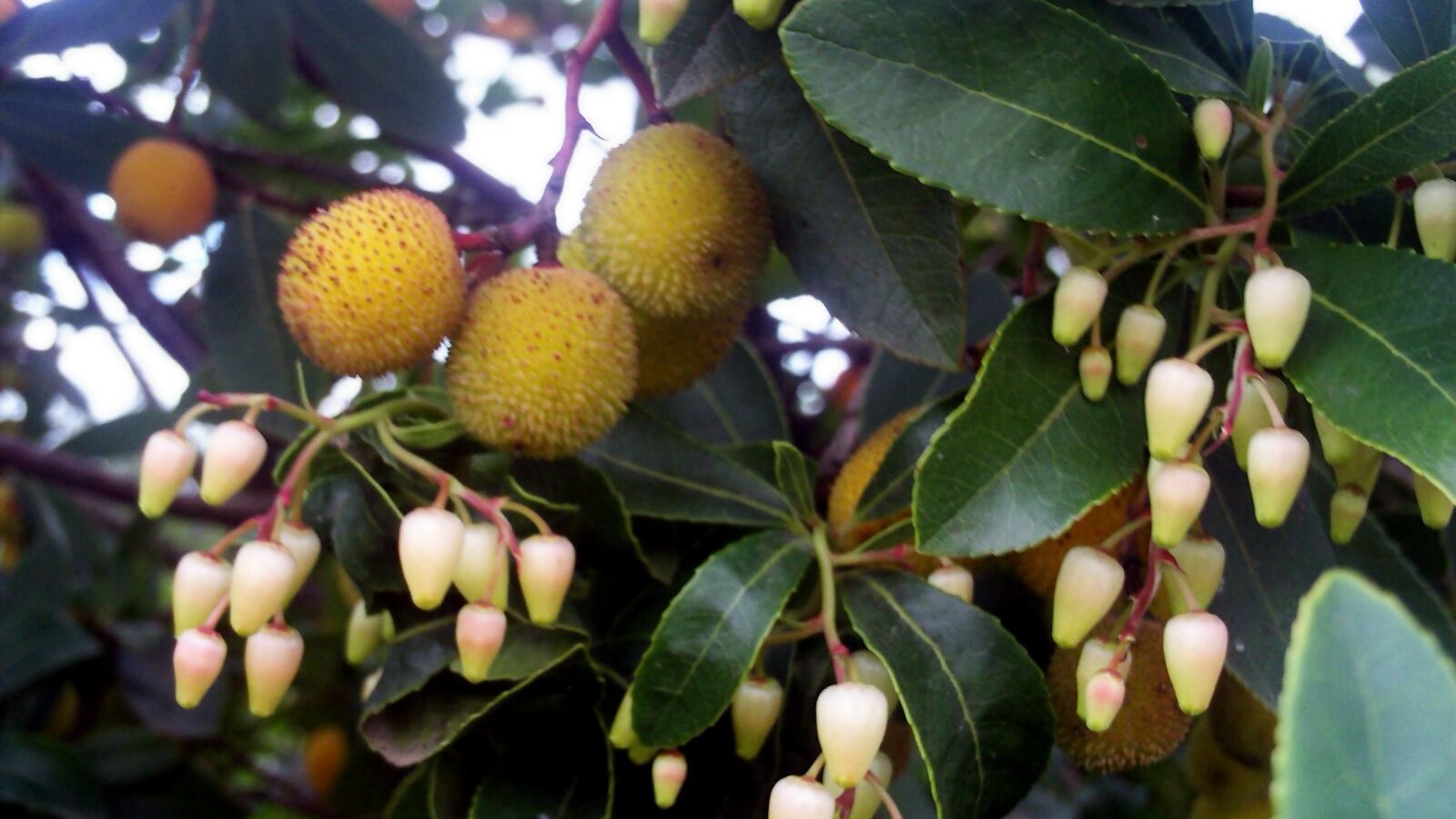
The strawberry tree's signature is that it carries this year's flowers and last year's fruit at the same time, in autumn.
The fruit takes a full twelve months to ripen, so as the tree flowers in autumn — clusters of white or pink bell-shaped blooms, like a heather's — the previous year's fruit is simultaneously ripening to red on the same branches. The effect of white flowers and red fruit together on an evergreen tree is genuinely lovely and quite unlike anything else.
The fruit is a round, warty, red berry that does look like a strawberry, hence the name. The species name unedo is said to come from Latin unum edo, "I eat one" — supposedly a comment on the fruit's underwhelming flavour. In truth ripe fruit is pleasant if bland and mealy, and it is made into jams, liqueurs (the Portuguese medronho), and preserves rather than eaten fresh in quantity. Unripe or over-eaten fruit can cause stomach upset.
The autumn flowers are a valuable late nectar source when little else is out, and Arbutus honey — dark and bitter — is a regional speciality. See pollinator habitat and native bees.
The lime-tolerant Ericaceae
The strawberry tree is worth knowing for a botanical oddity: it is one of the few members of the acid-loving heather family that tolerates lime and alkaline soil.
Where blueberries, rhododendrons, and most of the family fail and go chlorotic on chalk — the pH problem set out in soil pH — the strawberry tree grows happily on limestone and neutral to alkaline ground, as well as on acid soil. That makes it uniquely useful: an evergreen, flowering, fruiting, wildlife-friendly small tree for gardens where the rest of its family cannot grow.
Growing it
Full sun to light shade, free drainage, shelter. It tolerates a wide pH range, drought once established, salt wind, and urban pollution, and it dislikes only waterlogging and hard prolonged frost — it is hardy to about minus 10 to minus 15 C but cut back by severe winters, so it is a plant for milder temperate and Mediterranean climates.
Slow-growing, reaching 5 to 10 m, evergreen, with attractive rough, shredding, red-brown bark on old trees — the madrone in particular has spectacular peeling cinnamon bark.
Fire-adapted, as a Mediterranean plant: it resprouts vigorously from the base after fire, which is unusual and useful, and part of why it persists in fire-prone maquis. See fire management.
Few pests or diseases, though it can suffer leaf spot and, like other Ericaceae, is susceptible to Phytophthora root rot on wet ground. See tree diseases.
Grows from seed, which needs stratification, and from cuttings, which are slow. See propagation.
The strawberry tree is an excellent small evergreen for a mild-climate garden — autumn flowers and fruit together, good bark, wildlife value, drought and salt tolerance, and the rare gift of an Ericaceae that does not need acid soil. It fits well in a Mediterranean food forest or a dry garden. See Mediterranean shrubs and drought-tolerant species.
See also
- Blueberry and Acid Shrubs the acid-loving family it belongs to
- Soil pH and why the strawberry tree is the lime-tolerant exception
- Mediterranean Shrubs the companion dry-garden plants
- Fire Management resprouting after fire
- Pollinator Habitat the late autumn nectar
- Drought-Tolerant Species the dry-climate palette