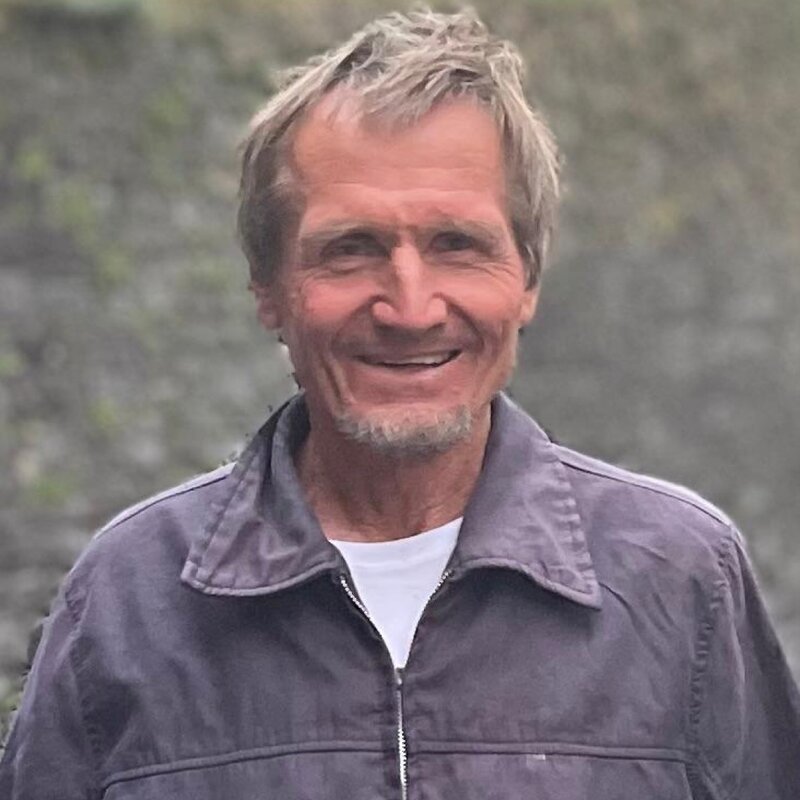
The Plant Breeder Who Changed His Mind
Ernst Götsch was born in Switzerland in 1948 and trained as a plant breeder and agricultural researcher.
His early career was spent doing exactly what the discipline expected: selecting and breeding crop varieties for higher yields under controlled conditions. He worked in Switzerland and later in Costa Rica.
The conclusion he reached was one his profession did not want. He came to believe that breeding better plants for degraded systems was solving the wrong problem. Yields were falling not because varieties were inadequate but because the systems they were grown in destroyed the conditions that produced fertility in the first place.
Better plants in dying soil is a treadmill. He decided the system itself was the object that needed redesigning.
Fazenda Olhos d'Água
In 1984 Götsch bought 480 hectares in southern Bahia, Brazil. Locally it was known as Fazenda Olhos d'Água, the Farm of the Eyes of Water, a name that had become ironic.
The land had been cleared, farmed, and abandoned. It was classified as unproductive. Its soil was exhausted, its 17 springs had dried up, and the surrounding region had lost most of its Atlantic Forest cover.
Götsch began planting. Not a plantation, and not a restoration project in the conventional sense of putting the forest back and leaving it. He planted a production system that would become forest.
Over the following decades the canopy closed, the soil deepened, and the springs returned. Local rainfall patterns changed measurably. The farm now produces high-quality cocoa within what is functionally forest, and it is one of the most-visited demonstration sites in tropical agriculture.
Syntropy
Götsch named the approach syntropic agriculture, from syntropy, the accumulation of order and energy that is the opposite of entropy.
His argument is that agriculture is normally entropic. It simplifies, extracts, and degrades, so it requires continuous inputs to hold a system in an artificially early state.
Natural systems do the opposite. Succession accumulates complexity, biomass, and fertility over time without anyone supplying anything.
The proposal is therefore to farm with succession rather than against it: plant the entire sequence at once, from the fast short-lived species to the climax trees, harvest from each stage as it passes, and use management to accelerate the transitions.
The practical structure is set out in syntropic agriculture. Every plant is classified by stratum, its light requirement at maturity, and by succession stage, its lifespan and role. Every stratum is filled, so no light is wasted and no niche is left open.
The Chainsaw as a Fertility Tool
The element that most distinguishes Götsch's practice, and the one visitors find hardest to accept, is how much he cuts.
Pruning in his system is not tidying. It is the primary fertility and energy input.
Cutting back a tree triggers a hormonal response. The root system, suddenly larger than the canopy it supports, sheds fine roots and releases organic matter and exudates directly into the soil. The cut material goes down as surface mulch. Light reaches the layer beneath, and the next stratum accelerates.
One action fertilises from below, mulches from above, and releases light at once. Götsch describes it as rejuvenating the system, and the rhythm is aggressive: banana, pigeon pea, and other biomass species are cut repeatedly through the year purely to feed the system.
Nothing is imported. No fertiliser, no compost from outside, no irrigation once established, no pesticide.
His position on pests is equally uncompromising: an unhealthy plant attracts pests because it is in the wrong place or the wrong stage, so the correct response to an infestation is a change in design, not a treatment. Compare the less absolute version in predator-prey balance.
Why It Matters
The significance of Götsch's work is not primarily the yields, though a mature system produces continuously across many products.
It is that the land improves while it is being farmed.
Most restoration requires land to be taken out of production and protected. Most agriculture requires soil to be gradually spent. Götsch's farm did neither. It regenerated a forest, restored a hydrological cycle, and functioned as a commercial cocoa operation throughout.
That combination is why syntropic methods have spread well beyond Brazil, and why they sit alongside assisted regeneration and the Miyawaki method as approaches that compress decades of succession into years.
The claim that vegetation restoration can change local rainfall, once treated as fringe, is now supported by a substantial body of work on forest–atmosphere coupling, including the flying rivers research in the Amazon. John D. Liu documented a comparable transformation at far larger scale on the Loess Plateau.
The Honest Caveats
Syntropic agriculture is knowledge-intensive and labour-intensive. It is low-input, which is not the same as low-effort, and it is frequently promoted as though it were.
Planting densities are far higher than trained growers find comfortable. The pruning rhythm requires someone who can read the system continuously. And it was developed in the humid tropics, where biomass accumulates year-round; temperate and dryland adaptations work but need a different species palette and a much slower tempo.
Götsch himself has been consistent that the method is a set of principles rather than a recipe, and that copying tropical spacings into a temperate climate produces a thicket rather than a system.
He continues to work in Bahia, teaching and consulting, and the approach has been adopted across Brazil and increasingly in Africa, Europe, and Australia.
See also
- Syntropic Agriculture the system in practice
- Food Forest Design the more familiar layered version
- Chop and Drop pruning as fertility at garden scale
- John D. Liu landscape-scale regeneration
- Cacao and Coffee the crop his system produces