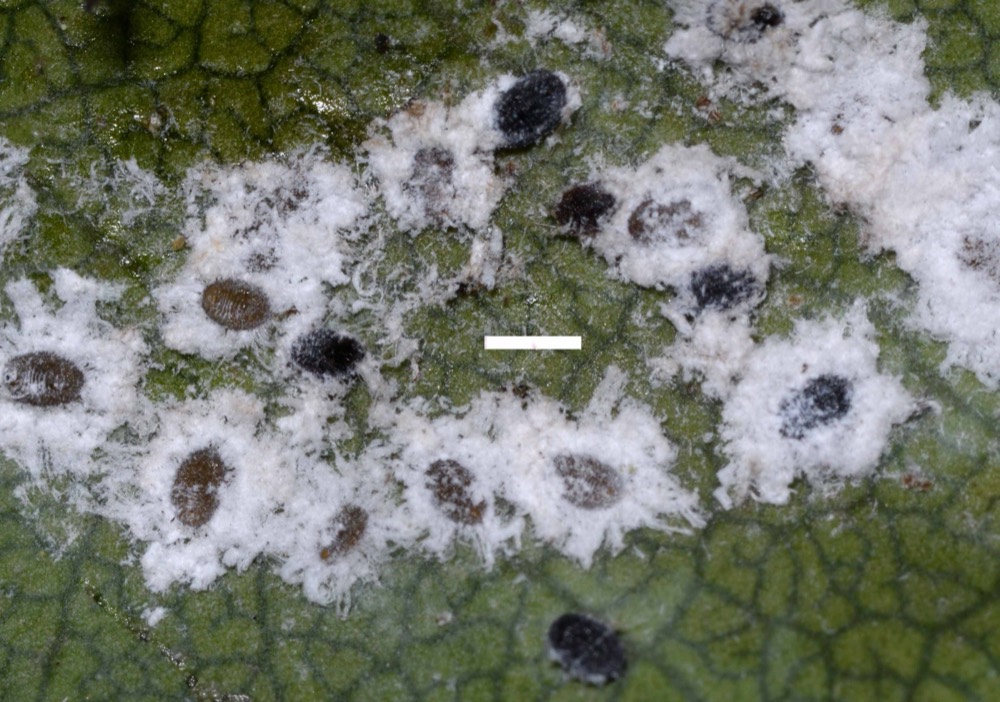
What they are
Three pests, one habit. All of them suck sap and leak sugar.
Cottony cushion scale (Icerya purchasi) sits on citrus and acacia like a fat white ridge with a fluted egg sac. Soft scales (family Coccidae) glue themselves flat to twigs and look like beads of brown wax. Mealybugs (family Pseudococcidae) walk slowly and wear a powdery white coat that water beads off.
Different families. Same plumbing. They all tap into the phloem and drink it.
Why the honeydew matters
A scale or mealybug colony pulls more sugar than it can use. The excess drips out as honeydew, a clear sticky film that coats leaves below the infestation.
Sooty mold (Capnodium and friends) lands on the honeydew and grows a black crust. The crust blocks light. Photosynthesis drops. A heavily infested citrus throws fewer flowers next spring, then fewer fruit, then starts shedding twigs.
The honeydew also recruits ants. That is the part most growers miss.
The ant problem
Argentine ants, big-headed ants, and most native sugar-feeders farm scale and mealybugs the way humans farm dairy cattle. They carry crawlers (the mobile juvenile stage) to fresh growth. They drive off lacewing larvae and ladybird beetles. They build dirt tents over scale colonies to hide them.
If you spray oil and skip the ants, the ants will rebuild the colony in three weeks. Cut the ants first.
A sticky band of Tanglefoot around the trunk, set 30 cm up, breaks the supply line on a tree. Refresh it monthly. For potted plants indoors, stand the pot in a saucer of water with a drop of dish soap. Ants will not cross. See Integrated Pest Management for the broader logic.
Spot it early
Run a finger under a leaf. If it comes back sticky, you have honeydew somewhere upstream. Walk the branch until you find the source.
Look at petiole junctions, leaf undersides, and the woody crotches where two stems meet. Mealybugs cluster in tight protected spots. Cottony cushion scale prefers smooth bark on younger branches. Soft scale lines up along midribs and twigs.
Yellow leaves, premature drop, and a glaze of black mold on the foliage below all point to the same problem. So does a steady ant trail running up the trunk.
Knock it back
Cotton swab and isopropyl alcohol. For a single houseplant or a small citrus, 70 percent rubbing alcohol on a cotton bud dissolves the waxy coat and kills the insect on contact. Touch each one. Tedious, but it works and it leaves no residue. Repeat weekly for three weeks to catch hatching crawlers.
Horticultural oil. The workhorse for anything larger. A 1 to 2 percent dilution of mineral or neem oil coats the colony and suffocates it. Spray to the point of drip, top and bottom of every leaf, both sides of every twig. Apply when temperatures sit between 5 and 30 Celsius and the plant is not water-stressed. Hot dry oil applications burn citrus leaves fast.
Strong water jet. A hard spray with a hose dislodges crawlers and washes off honeydew. Useful as a first pass before oil, or as the only treatment on tough-leaved plants.
Three applications, seven to ten days apart, clears most outbreaks. The gap matters. Eggs and protected crawlers survive the first spray and emerge into the second.
Bring in the predators
Australia imported the vedalia beetle (Rodolia cardinalis) in 1888 to save the California citrus industry from cottony cushion scale. It worked within two years and the program became the founding case study of classical biological control. The beetle is still out there doing the job.
For mealybugs the specialist is Cryptolaemus montrouzieri, the mealybug destroyer. A small dark ladybird with a tan head. The larvae look like oversized mealybugs themselves (waxy white tufts) which is how they walk into colonies undetected. Commercial insectaries ship them by the hundred for greenhouses and conservatories.
Green lacewing larvae (Chrysoperla) eat all three pest groups and tolerate a wider temperature range than Cryptolaemus. Release at dusk near active colonies.
Skip Trichogramma wasps. They parasitise moth eggs, not scale. Wrong family, wrong life stage. Marketing copy sometimes blurs this. Do not waste the order.
Tend the system
Predators only work if the ants are out of the picture. Band the trunks. Treat any indoor pots as quarantine cases until you confirm no ants.
Avoid broad-spectrum insecticides on infested trees. Pyrethroids and neonicotinoids knock down the lacewings and ladybirds faster than they touch the scale, and the colony rebounds into a clean field. Oil is selective enough to spare most beneficials once it dries.
Feed the host plant. A citrus pushed by excessive nitrogen throws soft new growth that scale and mealybugs prefer. Cut the feeding back. Mulch deep, water at the root, and let the leaves harden.
When it goes wrong
The colony comes back in a month. Ants. Check the trunk band, check for bridges of leaf litter or weeds touching the canopy, check neighboring plants for ant nests.
Oil burned the leaves. Wrong weather or wrong dilution. Spray in the cool of morning, never above 30 Celsius, never on a wilted plant.
Sooty mold persists after the pest is gone. It will. The mold lives on old honeydew and washes off slowly. A gentle soap rinse helps. New growth will come in clean.
The predator release vanished overnight. Two causes. Ants drove them off, or pesticide residue from a previous spray killed them on landing. Wait three weeks after any chemical before releasing beneficials.
The honest endpoint is balance, not eradication. A few scale on a healthy tree feed the predators that keep the next outbreak small.
See also
- Integrated Pest Management
- Aphids
- Whiteflies and Spider Mites
- Predator-Prey Balance
- Garden Pests Overview