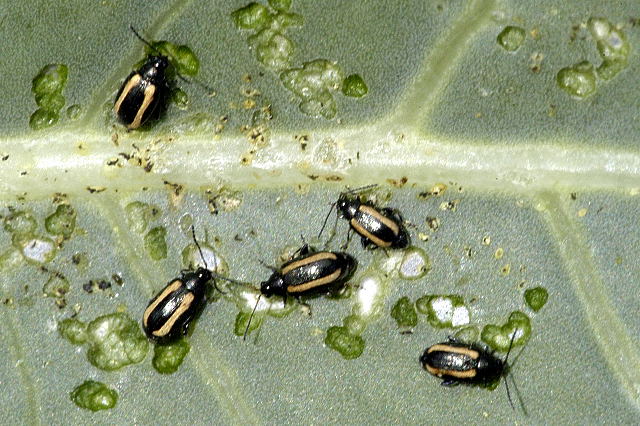
What they are
Tiny. Shiny. Black, bronze, or striped. 1.5 to 3 mm long.
Flea beetles are a tribe (Alticini) inside the leaf beetle family, with thousands of species worldwide. The name comes from the rear legs. Disturb a colony and the whole population launches like fleas, vanishing into the soil before you focus.
The damage is the giveaway. Pinholes, shotholes, lacework. A young brassica leaf hit hard at the cotyledon stage looks like someone took a needle to it. Eggplant, radish, arugula, turnip, mustard, and bok choy take the worst of it. Tomato and pepper sometimes get hit early but usually outgrow it.
Why a seedling dies and a mature plant shrugs
A two-leaf seedling has nothing in reserve. Lose 40 percent of leaf area in three days and the plant cannot photosynthesise its way back. A six-leaf plant with a thick cuticle and a real root system can take the same damage and barely flinch.
This is the whole game. Get the plant past the vulnerable window. Adult beetles overwinter in leaf litter, weed edges, and the top few centimeters of soil, then emerge hungry the moment soil temperature climbs past 10 Celsius. They find your bed in days. Your job is to make sure that the bed they find is either covered, decoyed, or full of plants tough enough to take the hit.
Cover the seedlings
Floating row covers work better than anything else.
Use lightweight insect mesh or spunbond fabric. Lay it loose over hoops the moment you transplant or direct-seed. Bury the edges with soil or pin them with sandbags. No gaps. Flea beetles will find a thumb-width opening.
Leave the cover on until the plants have four to six true leaves and the stems have hardened. For spring-sown arugula and radish, that is two to three weeks. For transplanted broccoli and kale, closer to four.
Pull the cover the moment brassicas flower if you want pollination, or earlier if heat builds underneath. Daytime air under unvented row cover can run 5 to 10 Celsius hotter than ambient. Watch for that in late spring.
Decoy them with mustard
Flea beetles prefer mustard to almost any other brassica. Use that.
Plant a strip of pak choi, southern giant mustard, or Chinese mustard one to two weeks before your main crop, and place it three to five meters upwind of the bed you want to protect. The beetles arrive, find the mustard, and stay there. Your kale and broccoli go in clean.
Two rules. Sow the trap dense (twice your normal seeding rate) so there is enough plant tissue to hold the population, and pull or flame the trap before the beetles complete their cycle and lay eggs in soil. Trap crops that get ignored become nurseries. See Trap Crops for the broader principle.
Strong seedlings take less damage
A flea beetle is an opportunist. A plant under stress (dry roots, weak germination, cold soil) sits in the bed longer at the vulnerable stage and gets hammered harder.
Start seedlings in a flat, not in cold soil. Transplant when the weather is settled and the soil is at least 12 Celsius. Water deeply at transplant, then again every few days until the roots take hold. A well-watered, well-fed brassica seedling can outpace moderate flea beetle pressure on its own.
The same principle runs through Integrated Pest Management. Healthy plant first, intervention second.
Hit the larvae underground
Adult beetles are the visible problem. The larvae feed on roots and root hairs in the top 5 to 10 cm of soil, and that is where you can break the cycle.
Heterorhabditis bacteriophora nematodes target flea beetle larvae. Mix the nematodes into water at the rate on the packet (usually 50 million per 10 square meters of bed), apply with a watering can in the evening, and keep the soil damp for a week. Soil temperature needs to sit between 12 and 30 Celsius for the nematodes to hunt.
One application in late spring knocks down the next generation. Repeat the following year if pressure stays high.
Dust the leaves when it gets ugly
Diatomaceous earth (food-grade) abrades the beetle's waxy cuticle and dehydrates it. Dust the upper and lower leaf surfaces in the morning, after dew has dried. Reapply after rain.
It only works dry. Wet diatomaceous earth is mud. It also hits any soft-bodied insect that crawls across it, including beneficials, so use it as a targeted rescue and not a routine spray.
A kaolin clay film (Surround WP) is gentler. It coats the leaf in a white powder that irritates the beetle's feet and confuses egg-laying. Effective and pollinator-safe, but it stains everything chalk white for the week it sits on the plant.
When it goes wrong
The row cover saved the kale, then the population exploded in July. The beetles cycled on weeds at the edge of the field while your crop was covered. Mow or pull cruciferous weeds (wild mustard, shepherd's purse, peppergrass) within ten meters of the bed.
The trap crop got eaten and the main crop got eaten anyway. The trap was too small or too close to the harvest. Push it further upwind, and at least triple the strip width.
Beetles came back two weeks after diatomaceous earth. It only kills on contact. New adults emerging from soil were never touched. Pair the dust with nematodes to break the underground stage.
Nothing works and the bed is destroyed. Pull the crop. Sow a buckwheat or rye cover until autumn to break the food chain, then plant brassicas in a different bed next year. See Crop Rotation.
The honest endpoint is timing, not extermination. Get the seedlings through the first month and the rest of the season is yours.